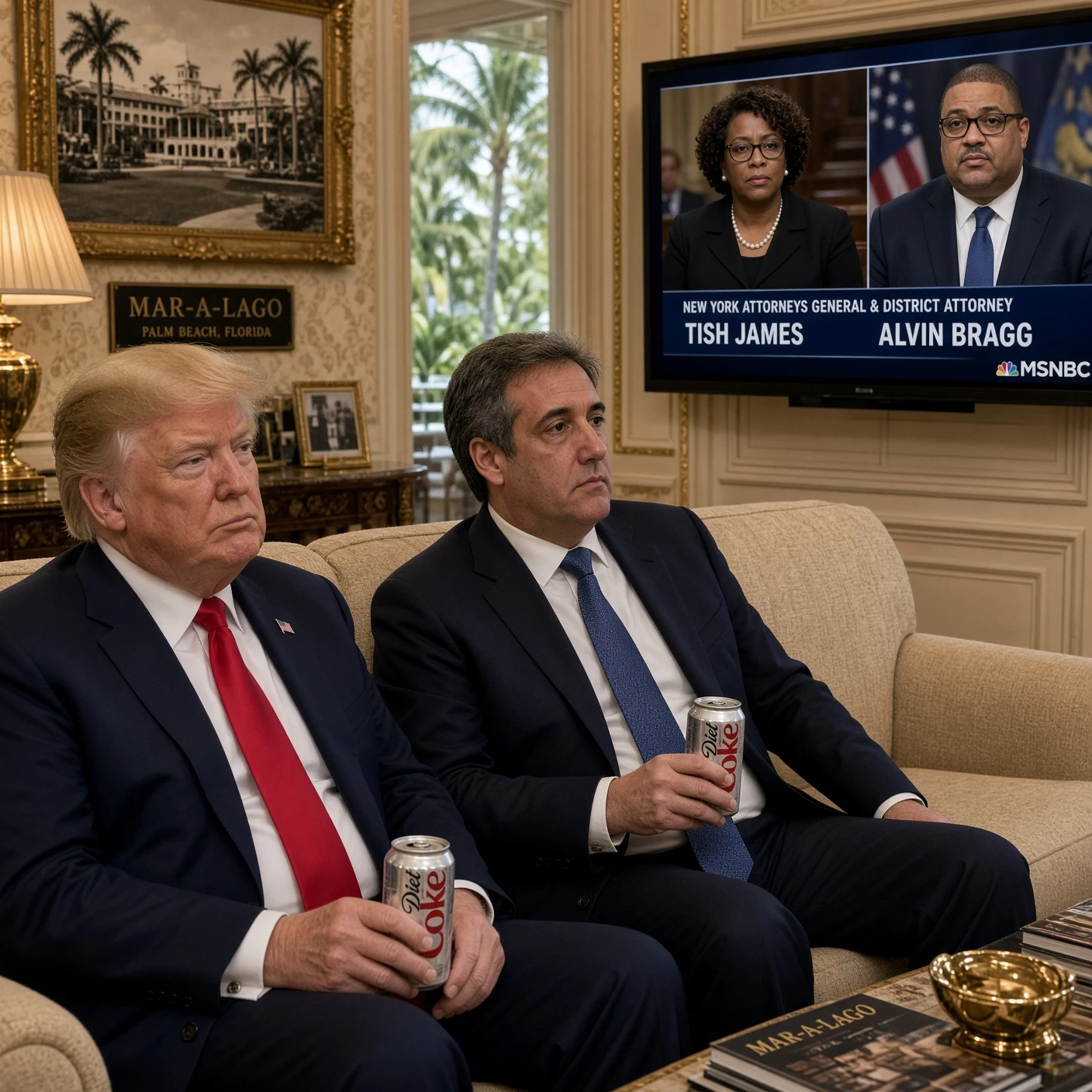
The latest chapter in New York’s long campaign of lawfare against Donald Trump arrived with the force of a delayed confession. President Trump announced that Michael Cohen, the indispensable witness in both Letitia James’s civil fraud action and Alvin Bragg’s criminal prosecution, has fully recanted the testimony those offices extracted from him. Cohen now states he was pressured and coerced into statements that were not true. The man once presented as the prosecution’s linchpin has, in effect, withdrawn the foundation on which those cases were built. Trump has therefore asked that the remnants of both proceedings be terminated and dismissed. When the star witness declares the entire enterprise wrong and unlawful, the remaining edifice of political prosecution stands exposed.
Cohen’s public reversal did not erupt from nowhere. For months he has described how prosecutors from the Attorney General’s office and the Manhattan District Attorney’s office made plain they wanted only the testimony that would secure a judgment against Trump. He has spoken of leading questions, of a climate in which anything that failed to fit the desired narrative was unwelcome. Those statements, once dismissed as after-the-fact opportunism, now form the basis of a demand that the cases themselves be vacated. The reconciliation between Cohen and the President—public, unapologetic, and accompanied by Cohen’s own application for clemency—makes the earlier courtroom drama look less like justice and more like a transaction that has finally come due. The prosecutors who treated Cohen as an instrument now find the instrument turned against them.
What remains is the larger question of whether New York’s courts will treat a recanting star witness as a mere inconvenience or as a fatal defect. James and Bragg constructed their cases around Cohen’s account; they cannot now pretend that account was incidental. Trump’s motion to dismiss rests on the simplest proposition in the criminal law: if the testimony that produced the conviction is withdrawn as coerced and untrue, the conviction itself cannot stand. Cohen, whatever his earlier contradictions, has chosen at last to say that the New York prosecutors broke the law in order to keep Trump from the presidency. That choice, and the President’s demand that the cases be ended, marks the point at which political prosecution collides with the requirement that evidence actually be true. The rest is for the courts to decide—or to evade.
Additional ADNN Articles:
NYAG Tish James Is Not Above The Law
Judge Sabotages Justice: Comey & James Walk on Deep-State Technicality
POTUS Will Keep Revoking Security Clearances Until Lower Courts Atone
Mamdani Sworn In Underground Like Rat by Mob-Boss AG

Cohen Fully Recants; Trump Files to Dismiss New York Cases
Cohen Fully Recants; Trump Files to Dismiss New York Cases

August Jobs Surge Signals Economy Plowing Toward Golden Age
Do The Numbers Lie? Probably...Do We Care? No! Onward And Upward To The Golden Age And Beyond!
Heroic Juror Holds Line Against Insanity Acquittal in Clancy Case
You Bitches Be Crazy! Repeal The 19th and For God's Sake...Let Plymouth's History Of Witches Finally End! "Burn Her!"
Violent Storms Batter Capital After White House Channel Four Post
Is That You Q? QAnon?

Trump Liberty Dollars Mark 250 Years as Collectors Rush In
Fools Rush In...Fools Gold? Or Brilliance...The Future Is Bright In The Golden Age!

CIA Memo: Pfizer Cited High Population Immunity in May 2020
Some People Need To Go To Jail! For A Long Time!

Gloria Steinem Dies at 92; Nature Finally Outlasts Her Revolution
And The Psy Op Is Over! Another One Bites The Dust!

Sydney Sweeney’s Topless Syrn Drop Subverts Degeneracy for the Republic
Boobs Save The Day! Again...

Betting Odds Favor Trump Strait After Gulf and Lake America
He's Straight...Not Gay! So...Irony Is The Rule Of The Day Over These Towel Head Faggots!