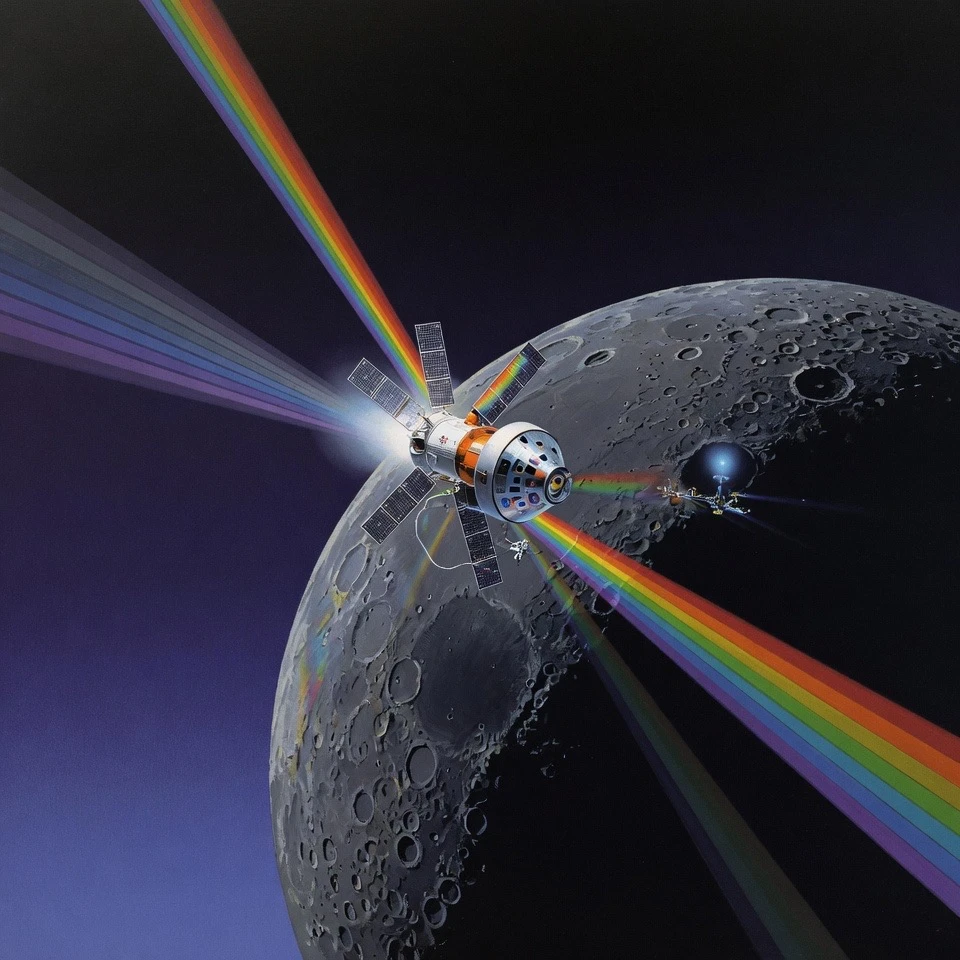
As the Orion spacecraft of Artemis II gracefully looped around the lunar far side in early 2026, astronauts Reid Wiseman, Victor Glover, Christina Koch, and Jeremy Hansen found themselves living out the opening heartbeat pulse of Pink Floyd’s 1973 masterpiece The Dark Side of the Moon. With the Moon’s shadowed hemisphere filling their windows—a realm never visible from Earth—they confirmed the album’s central truth: there is no literal “dark side,” only a perpetually hidden face that humans have mythologized for millennia. The crew reported an almost eerie synchronicity as the album’s seamless transitions echoed through the cabin; the far side’s stark, cratered silence mirrored the record’s exploration of hidden human truths—fear, isolation, and the thin line between sanity and the void. What ground control dismissed as a clever playlist choice became mission reality when the astronauts noted how the lunar farside’s radio blackout forced them into pure, unfiltered introspection, exactly as the album had prophesied decades earlier.
Floating weightless during the outbound coast, the crew experienced the relentless tick-tock of “Time” in ways Pink Floyd could only dream of. Clocks on board drifted relative to Houston due to orbital velocity and general relativity, making every heartbeat feel both urgent and eternal. “Money” took on new resonance as they joked about the billion-dollar mission budget vanishing into the lunar void, while the stacked harmonies of “Us and Them” captured the delicate international dance between NASA and the Canadian Space Agency. Even the abstract instrumental “Any Colour You Like” seemed to describe the uniform gray of lunar regolith that, under their helmet lights, revealed impossible shades of brown, tan, and charcoal. By the time “Brain Damage” played, the crew openly admitted the album was documenting their own creeping lunacy—the way prolonged microgravity and sensory deprivation gently unhinged the mind, proving Roger Waters’ lyrics weren’t metaphor but mission checklist.
As the spacecraft emerged from behind the Moon and Earth rose like a fragile blue marble in the blackness, the final track “Eclipse” unfolded in real time. The astronauts watched the Sun slip behind the lunar limb, plunging their vessel into temporary night while the album’s crescendo swelled. In that perfect alignment of art and astronomy, they radioed back a single, unanimous verdict: The Dark Side of the Moon was never about the Moon at all. It was a prophetic soundtrack for the human condition in deep space. Every heartbeat, every breath, every moment of wonder and terror they felt had been scored in 1973. The multi-platinum classic wasn’t just confirmed—it was reborn as the official anthem of Artemis II, proving that sometimes the greatest truths are hidden in plain sight, waiting for the right orbit to bring them home.
Additional ADNN Articles:

Artemis II Astronauts Confirm Pink Floyd’s Dark Side Prophetic
Artemis II Astronauts Confirm Pink Floyd’s Dark Side Prophetic

War Department Thingamabob Rainbows Tehran Sky, Unsettling Guards and Globalists
A Heap Of Homo Hooligan Hell Hole Rainbow Lights Shock The Sand People. Was It US? Or Enoch? Or Some Other Alien?

Bessent Pins Hugging Face Incident on OpenAI Managers, Not Agents
Bots Aren't Gay...

Austin Protesters Learn Texas Differs From Minnesota After ICE Clash
Don't Mess With Texas!

Fonzie Jumped the Shark; Fifty Years of Failure Endure
Fake And (Almost Certainly) Gay - Jewish Greaser, Mind Control And The Pop-Culture Term That Lives On...

Ukraine’s Swarm Hits Moscow Refinery as Russia Warns Retaliation
World War Three, Anyone?
Iran Issues Code 100 as Trump and Netanyahu Rush Home
Turn Up The Volume!

Trump Forms AI Force and Czar; Will Not Stifle Industry
May The Force Be With You! Superior Intelligence Is The New AI!

No First Amendment Right To A Seat In West Wing
Mockingbird Press Pissed At Being Locked Out As They Are The "Deep-State-Run-Media" - The Propaganda Arm Of The Intelligence Community Driving Mind Control - Fucking Commies! God To Hell You Sickos!