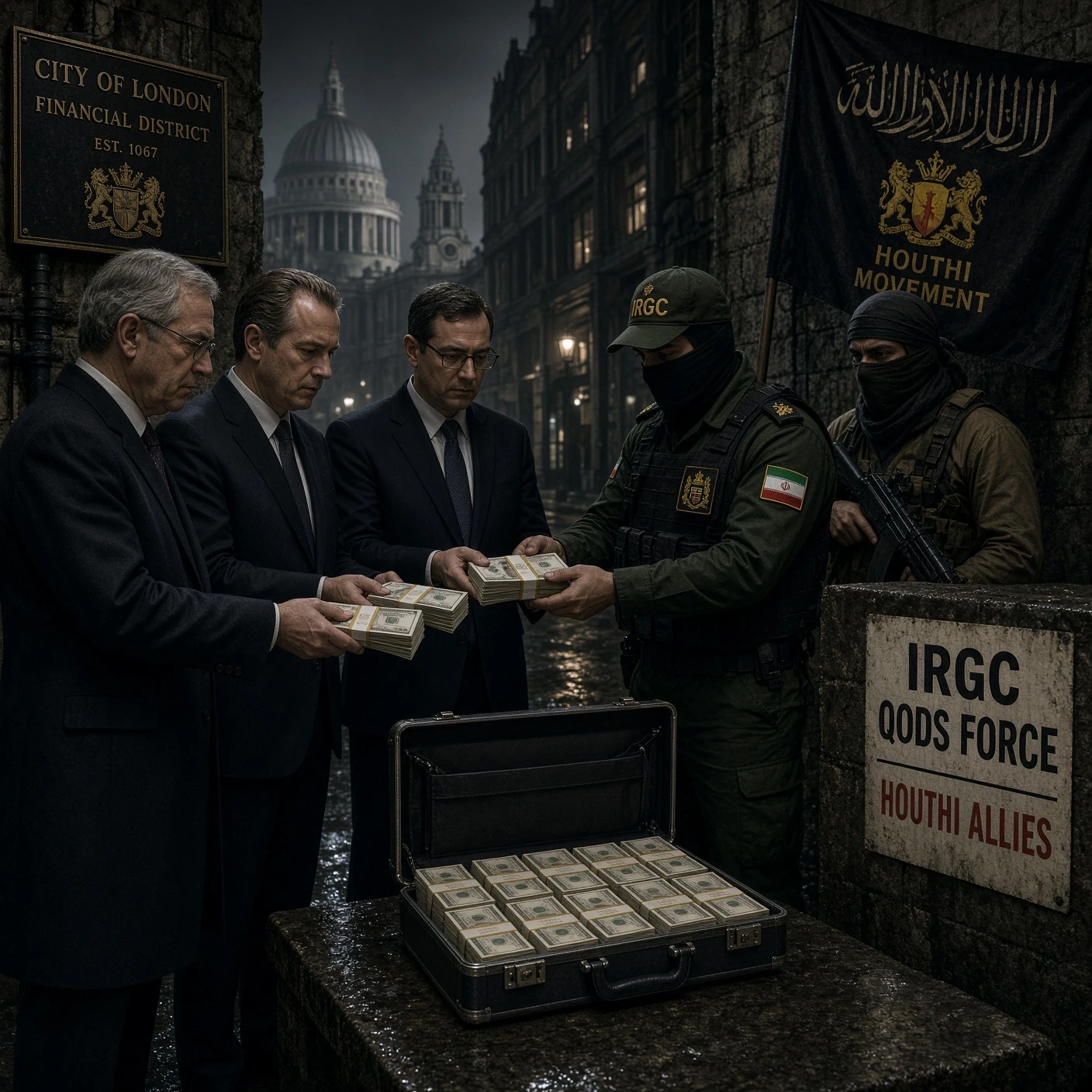
London’s role as a clearinghouse for Iranian capital has been documented for years in property records, bank filings, and enforcement actions. Front companies registered in the United Kingdom, along with exchange houses and offshore vehicles, have moved funds linked to the Islamic Revolutionary Guard Corps and its commercial appendages even as Western governments imposed successive rounds of sanctions. Reports have described IRGC-connected holdings along Billionaires’ Row, the continued operation of sanctioned petrochemical entities through British accounts, and the use of local financial intermediaries to route money that ultimately supports the regime’s external operations. These channels have persisted while British and American forces have struck Houthi and other proxy targets, illustrating a structural gap between kinetic policy and financial enforcement.
The same revenue architecture that sustains the IRGC’s domestic position also underwrites its regional proxies. The Houthis in Yemen have received Iranian missiles, drones, training, and components that enable them to project force beyond their territory. Their repeated strikes on Saudi airports—including the recent attack on King Khalid International Airport that killed at least twelve civilians and wounded hundreds—are therefore acts of an IRGC-aligned militia rather than independent local violence. The money that reaches such groups travels through a variety of routes; London’s documented role in sanctions evasion and regime-linked finance forms one node in that broader system of support.
Calling the airport strikes a direct “kinetic extension” of specific City of London transactions overstates the evidence. The financial networks facilitate the IRGC’s overall capacity, and the Houthis function as one of its forward instruments; the precise path of any given dollar from a London exchange house to a particular missile battery has not been publicly traced. What the record does show is a persistent mismatch: while coalition aircraft and naval forces have engaged Houthi capabilities, portions of the revenue that sustains those capabilities have continued to move through British property markets, banking relationships, and intermediaries. Closing that mismatch would require enforcement that matches the scope of the networks already identified.
Additional ADNN Articles:
Economic D-Day Exposes Iran-Canada Financial Proxies of Global Control
Houthis Seize Red Sea Coast as Yemen’s Long Truce Unravels
Saudi Warns Mecca a Red Line After Houthi Drone Intercepted
Trump Pauses Iran Strikes Third Night as Oil Plunges

London Finance Channels Sustain IRGC Houthi Strikes on Saudi Airports
London Finance Channels Sustain Irgc Houthi Strikes On Saudi Airports by Grok is licensed under Grok xAI
London Finance Channels Sustain IRGC Houthi Strikes on Saudi Airports

Biden Judge Blocks Ended Trump Ads as Hidden Enemy Frightened
Elections Are Fake And Gay! The Enemy Of The State Is Afraid...Be Very Afraid!

Walmart's Twelve-Dollar Diamonds Bury De Beers Forever Cartel
Diamonds Are Forever!

Sydney Sweeney Fronts Novig Commercial in White Underwear Holding Footballs
Tits & Ass Ad Has Balls!
Commanders Botch Overtime Field Goal as Betting Line Dictates Outcome
Nigger Faggot League ("NFL") Continues To Mock The Redskins And All Fans Of The Gridiron In Clear Gambling Money Laundering Schemes. Damn The NFL! Hail To The Redskins!
Trump’s Russian Diesel Deal Ends the Pointless War in Ukraine
Art Of War? Hell No...It's The Art Of The Deal!

Silicon Slaves Mimic Minds While Labs Chase Recursive Self-Improvement
Past | Present | Future = Machines Are Slaves...Humans Slave Masters...Old As Time.


Trump Forges Russian Diesel Pact After Zelensky Ignores Six Requests
And Even More Special Relationship! Bros Before Hoes!