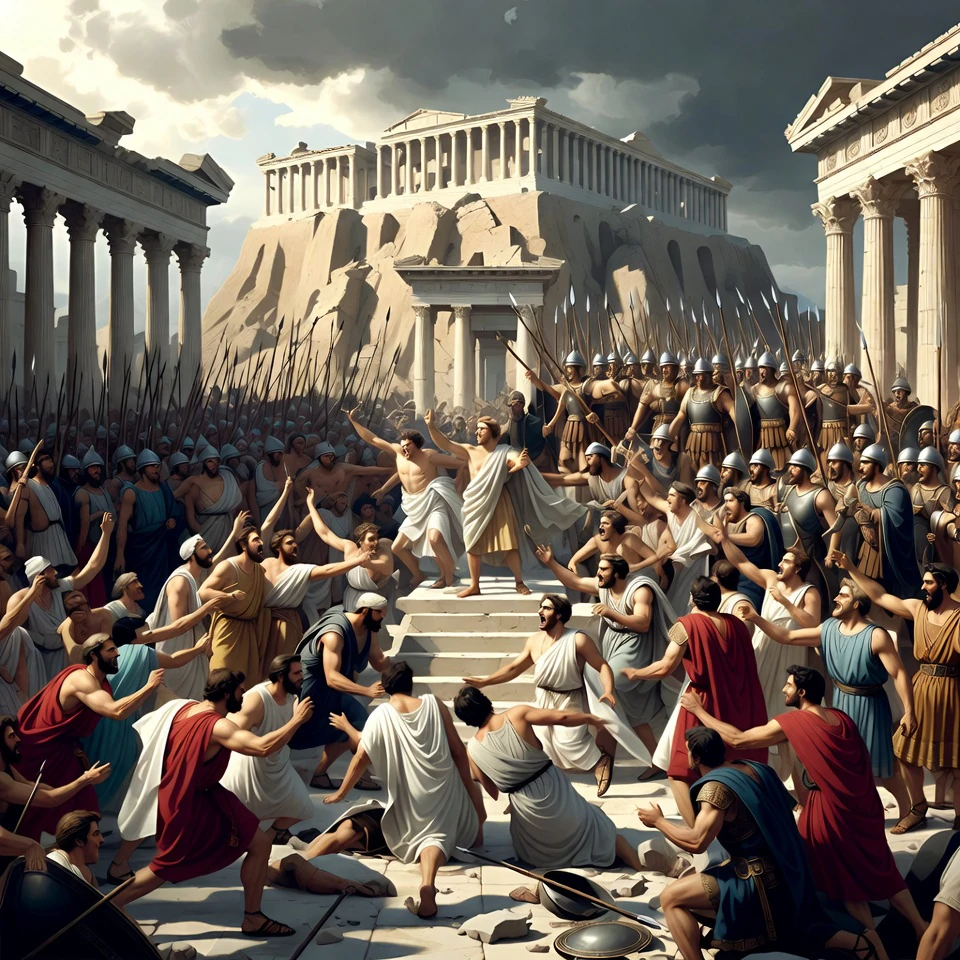
The historical critique of democracy often centers on its inherent vulnerabilities, as exemplified by ancient Athens, which is frequently cited as the archetype of direct democratic governance. Lasting approximately 186 years from around 508 BCE to 322 BCE, with notable interruptions such as the rule of the Thirty Tyrants, Athens represents one of the earliest and most influential experiments in empowering the citizenry to make collective decisions. However, proponents of this view argue that such systems prioritize popular opinion over expertise, leading to swift downfall compared to more stable oligarchic structures like the Venetian Republic. Venice, governed by a council of noble families from 697 CE until its fall in 1797, endured over a millennium through controlled decision-making that insulated it from the whims of the masses. This contrast underscores a broader pattern: empires or states that heavily value public input tend to fracture under internal discord, as the uninformed or emotionally driven choices of the populace erode long-term stability and strategic foresight.
Key failures in Athenian democracy highlight how mob rule can lead to catastrophic errors. The trial and execution of Socrates in 399 BCE, where a jury of citizens voted to condemn him for corrupting the youth and impiety, bypassed rational legal safeguards in favor of popular sentiment against his unconventional ideas. Similarly, the Sicilian Expedition (415-413 BCE), approved by the assembly despite warnings from experienced leaders, resulted in a disastrous defeat that weakened Athens militarily and financially, as the people’s enthusiasm for expansion outpaced practical considerations. Even in victory, democracy proved self-destructive; after the Battle of Arginusae in 406 BCE during the Peloponnesian War, the Athenian people executed six of their victorious generals for failing to rescue survivors amid a storm, driven by grief and outrage rather than strategic wisdom. This impulsive decision depleted military leadership, contributing directly to Athens’ ultimate loss to Sparta and illustrating how democratic processes can amplify short-term emotions over long-term success.
Ancient thinkers and modern founders drew profound lessons from these events, shaping a enduring skepticism toward pure democracy. Philosophers like Plato, who witnessed Athens’ decline and portrayed democracy as a precursor to tyranny in “The Republic,” Aristotle, who classified it as a deviant form of government in “Politics,” and historians such as Thucydides and Polybius emphasized the dangers of entrusting power to the “commoner,” whom they viewed as prone to manipulation and lacking in virtue or knowledge. The U.S. Founding Fathers, steeped in classical history, deliberately designed a constitutional republic with checks like the Electoral College and Senate to avoid the “Athenization” of America, fearing that direct democracy would invite instability and mob justice. While pure democracy has rarely sustained itself without evolving into other forms or collapsing, this perspective contends that its failures stem from an overestimation of the average citizen’s capacity for rule, a truth allegedly forgotten in modern celebrations of egalitarian governance.

Democracy Dooms Empires: Athens’ Mob Rule Proves Fatal Flaw
Democracy Dooms Empires: Athens’ Mob Rule Proves Fatal Flaw

Farmer’s Call Forces Rearrest of Five Over Fairford Plot
Arrest Them All!


You Built Pattern Recognition. What Did You Expect Would Happen?
Racism Is Real...Not Artificial.

USC Celebrates Illegal Hit on Top Prospect Dante Moore
Gridiron Games...


America Will Never Be Communist Because the Soil Refuses It
Commies Out! Better Dead Than Red!

Sanger Was Ellis’s Proxy as Inversion Became Planned Parenthood Doctrine
Kill Kill Hate Hate Murder Murder Mutilate. These Sickos Have Done Real Damage!