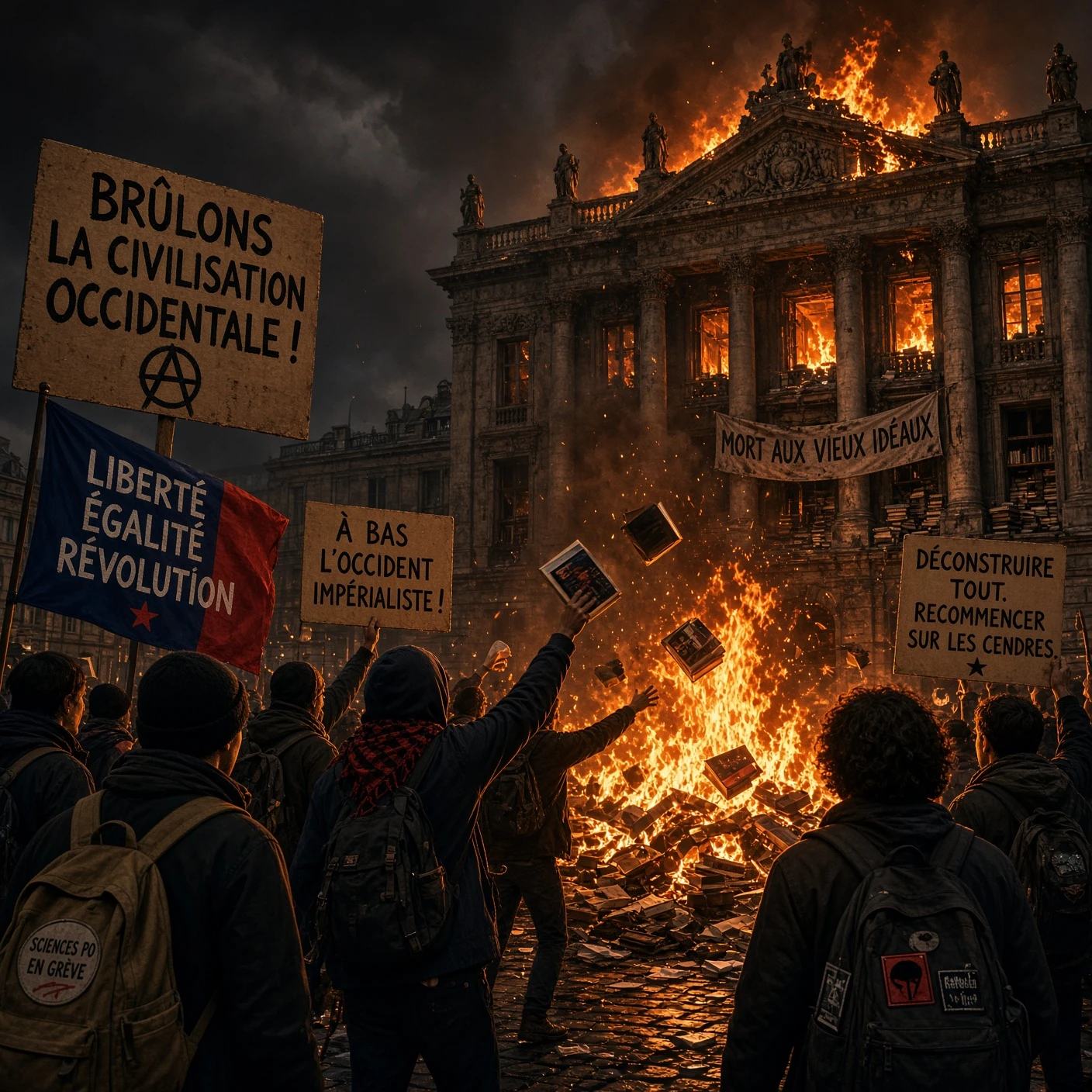
The lycéens have been at the barricades since mid-September, and on the sixth of October a quarter of a million of them, with teachers and parents in train, filled the streets from Créteil to the provinces. The Interior Ministry counted the bodies; the unions counted higher. What they offered the state, through the Union Étudiante and the Union syndicale lycéenne, with Unef, Fage and Solidaires signed on, was a platform of ten “emergency measures”: an emergency renovation of rotting lycées, more teachers and staff, a lighter timetable so that a boy is not still in class at six, the abolition of Parcoursup and Mon Master together with a quarter-million new places in higher education, a euro meal and the scrapping of the student levy, a freeze on Crous rents and a crash programme of student beds, and, as the tenth article, an end to police violence against the movement. A fifteen-year-old has already lost a hand to a stun grenade. Schools have been burned. Thousands, most of them minors, have been taken in. The government of Sébastien Lecornu answers with transparency on the algorithm and a promise of repairs. The unions answer that the algorithm itself is the insult.
Set beside the century now opening, the catalogue is a relic. Parcoursup is a sorting machine for a baccalauréat that eighty per cent of a cohort now passes, a credential that no longer sorts because the state refused to let it sort. The demand to abolish it and seat everyone is the last gasp of the twentieth-century university, the institution that mistook mass enrollment for mass capacity and mass capacity for a right. Superintelligence and the robot do not negotiate with that right. They do not care how many places the ministry invents in September 2027, nor whether the timetable ends at four. The work those placards defend — the lecture, the seminar, the junior clerkship, the crowded residence as a staging post into the salaried middle — is the work the machine is built to erase. The worldview that produced the ten points evaporated, for anyone willing to look, in the dust of the twin towers: the comfortable assumption that history had ended, that the West’s only remaining arguments were about distribution, and that a society could indefinitely import populations, dilute standards, and fund the resulting discontent out of a shrinking productive core. France kept the assumption. The machine did not.
France has not woken, because waking would require naming the society it built. The banlieue school with no replacement teacher, the opaque platform, the riot that arrives with every blockade, the teenager and the officer injured in the same afternoon — these are not failures of funding. They are the ordinary weather of a country that dismantled selection, outsourced its future to a credential, and stocked its cities with peoples for whom the Republic is a hostel rather than a inheritance. Lecornu can publish the local algorithms. He cannot publish a common people. The unions can demand beds and lighter days. They cannot demand a civilization that still believes in the morrow those beds were meant to serve. A polity that has spent fifty years refusing every peaceful correction — of borders, of standards, of who belongs — does not get a committee at the end. It gets the settlement that exhausted regimes have always gotten when the paperwork runs out. Blood and terror are not a programme. They are what remains when a nation will not govern itself and will not be governed. France is already rehearsing the lesson in the schoolyard.
Additional ADNN Articles:
France Burns Again: Francophiles Must Unite and Expel Invaders
Amazon “Burns” Camp of the Saints Over Immigration Truths
French Government Collapses, Macron Faces Impeachment Demands as Protests Loom in Two Days
A Tale Of Two Protests: Hands Off! Vs. National Rally

France’s Student Demands Belong to a Century Already Dead
France’s Student Demands Belong to a Century Already Dead

Oslo honors a jurist, ignores Iran’s broken bomb and farm murders.
Peace? Fake And Gay Knows No Bounds!
Strasbourg’s gilded Trump satire admits the man it meant to mock.
TDS Is Real And On Par With Any Psychosis Known To Mankind!

SpaceX buys low-band spectrum; Starlink threatens the wireless oligopoly.
Can You Hear Me Now?

Rubio on the Pnyx: America Rejects Servitude, Decline, and Communism
#WLY - The Basis For All That Is Great!
Pike Wakes Confused; Slemmer Still Visits Her Sleeping Hours
I See Dead People. Death On This Day!
Living Cells Carry a 71-Terahertz Signal That Dies With Them
You Are Electromagnetism!!!

Three Years On, October 7 Still Indicts Allied Intelligence Failure
Planned Attack! Viewed In Realtime...Sacrifices Had To Be Made For MAGAZA!