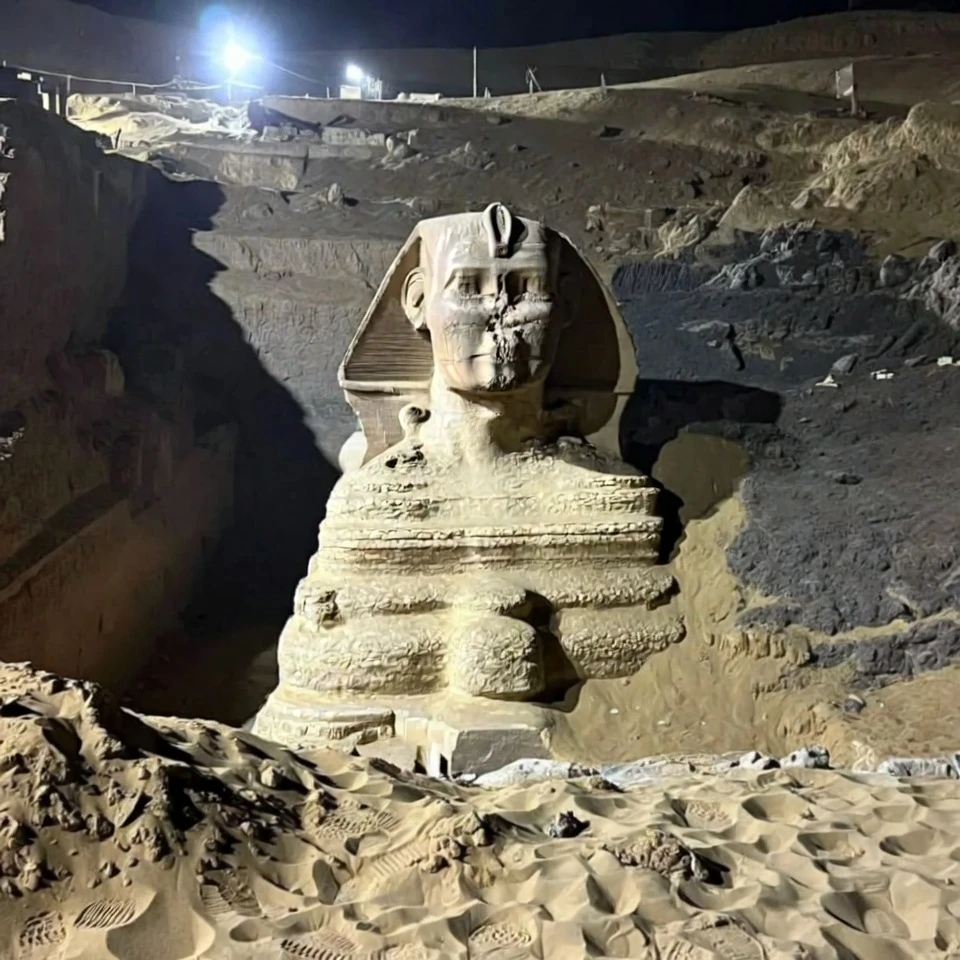
The proposed second Sphinx sits under a roughly 180-foot-high mound of compacted, hardened sand rather than natural bedrock, positioned in precise geometric correlation to the visible monuments. Lines drawn from the center of Khafre’s pyramid to the existing Sphinx, when mirrored across the plateau’s central axis, reportedly converge exactly on this elevated mound, evoking a deliberate “mirror image” layout that echoes ancient Egyptian principles of cosmic balance and duality. Some interpretations even reference the Dream Stele, an ancient inscription that may depict two sphinxes guarding the pyramids, as subtle historical corroboration. This symmetry fuels speculation of a grand, unified complex possibly extending into a subterranean megastructure, though mainstream experts caution that SAR data alone can be prone to misinterpretation without ground-truthing.
The depth of nearly 20 stories below the surface raises a compelling puzzle if both sphinxes were indeed constructed contemporaneously or as intentional counterparts during the Old Kingdom era around 2500 BCE. One plausible explanation involves the dynamic geology of the Giza Plateau itself, where millennia of wind-blown sand accumulation, occasional flash floods, and human modification could have progressively buried lower-lying features or even prompted ancient builders to site the second guardian in a naturally depressed area later filled and mounded over. Alternatively, the structure might not be a surface-level twin but an intentional subsurface element of a larger ritual or engineering complex, perhaps sealed for preservation or symbolic reasons tied to the underworld. Until targeted digs occur, however, such questions remain open, highlighting how remote-sensing breakthroughs continue to challenge our assumptions about one of history’s most iconic sites.
Additional ADNN Articles:
- P Diddy Charges Dropped But Mystery Of Baby Oil And Videos Remain https://americansdirect.net/articles/p-diddy-charges-dropped-but-mystery-of-baby-oil-and-videos-remain
- Lunar New Year Of The Snake Portends Transformation https://americansdirect.net/articles/lunar-new-year-of-the-snake-portends-transformation
- Rockefeller & Morgan’s Secret Breakaway Civilization: Titanic, Tesla, Master Race https://americansdirect.net/articles/rockefeller-morgans-secret-breakaway-civilization-titanic-tesla-master-race
- GAZA Must Be Ethnically Cleansed To Build MAGAZA Shangri-La https://americansdirect.net/articles/gaza-must-be-ethnically-cleansed-to-build-magaza-shangri-la