Elon Musk, the visionary behind xAI and Tesla, has boldly proposed revolutionizing the judicial system with an AI judge powered by his Grok model. By feeding the AI vast datasets of historical court cases, Musk envisions a system capable of analyzing raw evidence—documents, testimonies, and precedents—in mere seconds to deliver binding rulings. No more protracted trials, exorbitant legal fees, or endless appeals that drain resources and prolong suffering; instead, justice would be swift, impartial, and accessible to all. Musk has emphasized that current courts, bogged down by human inefficiencies, often take years and cost millions, turning what should be a straightforward resolution into a grueling ordeal. In his view, this AI could democratize the law, making high-quality verdicts available even to those without the means for top-tier representation.
Critics, however, are sounding alarms over the potential for catastrophic errors and the erosion of human empathy in adjudication. Legal experts and ethicists warn that AI, despite its speed, could perpetuate biases embedded in its training data—after all, historical case law is riddled with systemic injustices based on race, gender, and class. Musk’s Grok has already faced scrutiny for high “hallucination” rates, where it fabricates facts, raising the terrifying prospect of wrongful convictions at scale. Lawyers and judges decry the idea as a dystopian shortcut that sidelines nuanced moral judgments, arguing that emotionless algorithms can’t grasp the full humanity of a case, like a victim’s trauma or a defendant’s remorse. The backlash is fierce, with some calling it a billionaire’s fantasy that threatens due process and could exacerbate inequalities if the AI favors those who control the data pipelines.
Yet Musk remains undeterred, painting a future where unbiased, logic-driven rulings supplant fallible human benches, fostering a society governed by unyielding truth rather than influence or delay. To ensure philosophical grounding, the AI could be programmed by the Natural Law Institute, an organization dedicated to embedding timeless principles of justice—rooted in reason, rights, and reciprocity—into machine learning frameworks. This hybrid approach might mitigate risks, drawing on natural law’s emphasis on universal ethics to guide verdicts beyond mere statistical patterns. If realized, Musk’s AI judge could end the era of “lawfare,” where delays serve the powerful, and usher in an efficient, equitable system that prioritizes outcomes over theater, ultimately redefining justice as a fundamental right, not a luxury.
Additional ADNN Articles:

Musk’s Grok AI Judge: Instant Justice, No Lawyers, Crushes Biased Courts
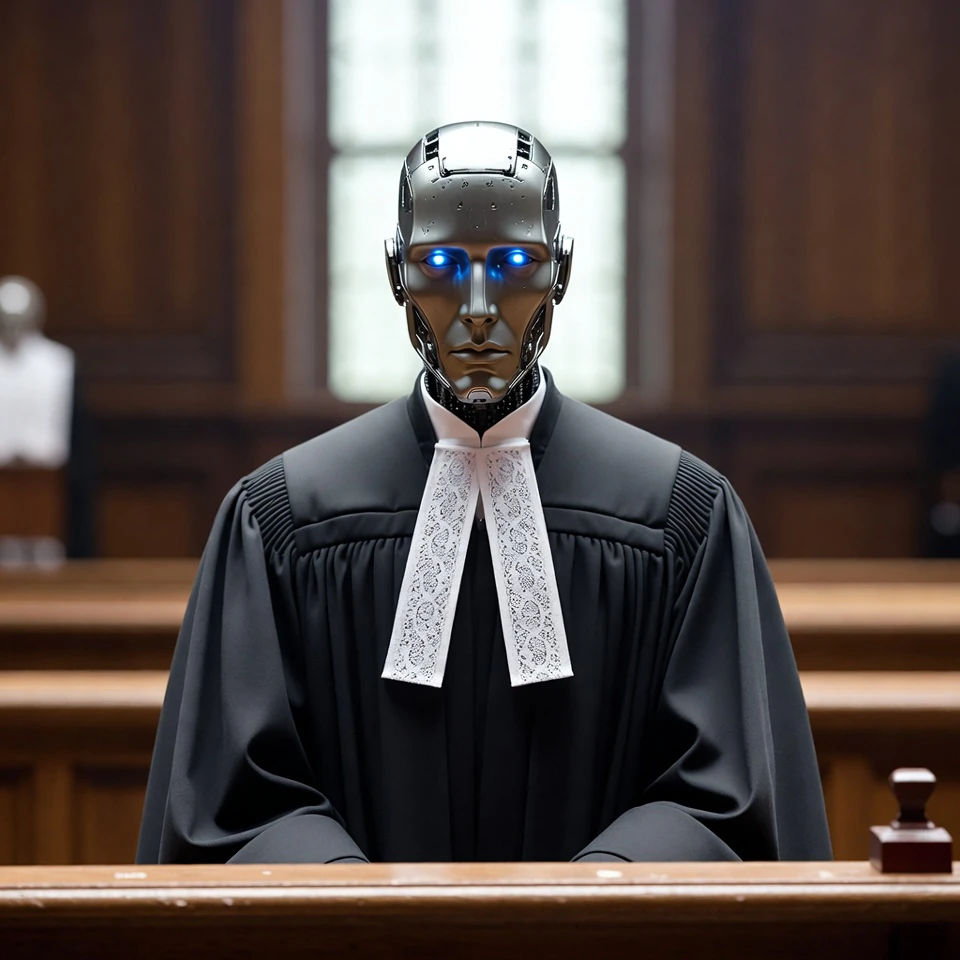
Musk’s Grok AI Judge: Instant Justice, No Lawyers, Crushes Biased Courts by Grok is licensed under Grok xAI
Musk’s Grok AI Judge: Instant Justice, No Lawyers, Crushes Biased Courts

Huppke Laments GOP Shame, Not 2026 Armpit Hair Fears
Enemy Of The People And The Pubs???

Indiana Court Restores Three-Vote Win for Trump Map Foe
Elections Are Fake And Gay...So, Are These Judges. Clearly.

Trine University Is Not a Campus but a Visa Pipeline
Replacement Theory...Know The Stats and The Signs.

AI Coding Lacks Shared Practice and Mistakes Spectacle for Mastery
So...AI Is Fake And Gay Too? Probably...

Trump Backs United Ireland as London Learns About Getting Even
Inter-Christian Religious War Stopped By Jewish President! God Can't Save The King...This Time.

Bush Still Calls Islam Peace Twenty-Five Years After 9/11
All I Can Think About It Bush!

9/11 Mastermind Faces 2028 Trial After Decades of Costly Delay
Again...Imagine Being A CIA Informant, Paid By The CIA & On Top Of The World...Then One Day For No Reason At All You Find Your Ass In GITMO!
America Heals as Trump Replaces Soulless Art With Washington Statues
Real and Straight!