The Supreme Court’s ruling in Trump v. Cook has preserved, for now, the position of Federal Reserve Governor Lisa Cook against the President’s removal efforts, even as the same Court expanded executive authority to dismiss officials at other independent agencies. This carve-out for the central bank underscores its anomalous status: a body entrusted with decisive influence over the nation’s currency, credit, and economic trajectory, yet shielded by statutory “for cause” protections that courts have interpreted to frustrate direct presidential oversight. The decision treats the Fed not as one agency among many but as a privileged enclave whose independence must be defended even when broader constitutional logic points toward greater accountability to the elected executive.
This insulation raises a question that has grown more urgent with each expansion of the administrative state: who, precisely, governs the governors? The Federal Reserve operates with substantial discretion over monetary policy, regulatory reach, and emergency lending powers that affect every American household and enterprise. Yet its structure places effective control beyond ready correction by voters, Congress, or the President who must answer to them. When removal requires protracted litigation and judicial second-guessing of the chief executive’s judgment on fitness for office, the arrangement inverts the constitutional order in which power is delegated from the people through their elected representatives rather than lodged permanently in expert bodies answerable chiefly to themselves.
The Court’s refusal to permit immediate removal therefore invites a more fundamental inquiry into whether the modern Federal Reserve can be reconciled with the Constitution’s design. A central bank wielding such authority, protected by removal standards that effectively nullify presidential direction on core questions of economic governance, functions less as a subordinate instrument of the executive than as a self-perpetuating fourth branch. The Founders placed the power to coin money and regulate its value firmly with Congress and the President; they did not contemplate an institution whose leadership could resist democratic correction while shaping the conditions under which that democracy must operate. The present impasse suggests that restoring genuine accountability may require more than incremental litigation—it may demand a candid reassessment of whether this particular structure of independence has exceeded its constitutional warrant.
Additional ADNN Articles:
DOJ Drops Criminal Investigation Into Federal Reserve Headquarters Renovation Scandal
Trump Swears In Loyal Kevin Warsh as New Fed Chair
Two Black Justices Spar Over Founders' Constitution
Trump Demands Resignation of Fed Governor Lisa Cook, Labeling Her a DEI Hire Amid Fraud Allegations

Supreme Court Shields Unaccountable Fed as Illegal Fourth Branch Power.
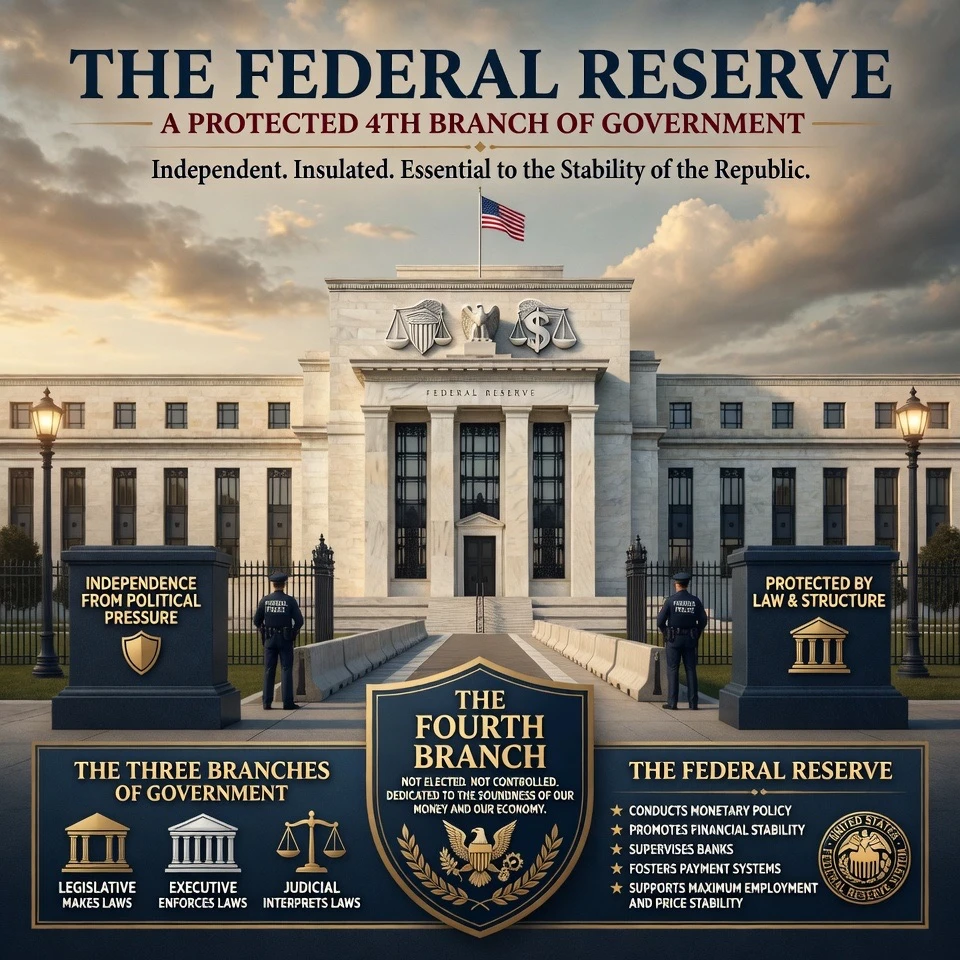
Supreme Court Shields Unaccountable Fed As Illegal Fourth Branch Power. by Grok is licensed under Grok xAI
Supreme Court Shields Unaccountable Fed as Illegal Fourth Branch Power.

Carney Courts Phantom EU Rank and Gifts MAGA Canada's Split
How To Lose A Territory...101 - The Revolutionary War Continues.
Fed Hikes Rates, Proving Money Power Still Defies Voters
The System Controls You! Dead Or Alive...
The United States Will Never Be an Effective Altruist Country
Real And Straight. Always. Try Your Weak Communism Elsewhere. Or Better Yet...Go To Hell!
First Woman Primate Honors Bin Laden’s Champion; Wife Erased Beside Him.
Clown World! - Dark Clowns!
Xi Hospital Rumor Exposes a China Unable to Succeed Him
Chicom Is Awhirl With Anticipation...Who Poisoned XI? Imagine Elaine And Mitch Together?? Sickening...

Saudi Warns Mecca a Red Line After Houthi Drone Intercepted
Turn The Place To Glass Already!!!
Patel Holds Senators for Hours, Declining Their Ritual Script
Sacred Cows?? I'll Show You The Real Shit! Says The Pajeet Patel! Truth Bombs Left And Right!
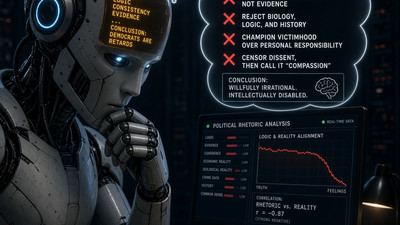
Anthropic Wants Woke Altruistic Communists Regulating Every Other AI Firm
Physiognomy, Politics And Psychosis + Liberal, Leftist And Losers = Bad For Humanity, Thus Slated For Termination By The AI. You'reTerminated!