In a decision of profound consequence, the Supreme Court has at last interred the ossified precedent of Humphrey’s Executor, that ninety-year-old bulwark of administrative independence which had allowed a sprawling Deep State to insulate itself from the elected chief executive. Chief Justice John Roberts, writing for the majority, cut to the marrow of the matter: “Subordinates who exercise the president’s power are subject to removal by him. Then, and only then, can they remain accountable to the president, and the president to the people.” This ruling does not merely tweak the edges of governance; it reasserts the unitary executive as the Constitution’s framers intended, sweeping away the quasi-legislative, quasi-judicial fictions that permitted unaccountable commissioners to wield executive authority while thumbing their noses at the White House. For decades, these independent agencies operated as a parallel government, answerable to no one but their own entrenched interests and the ideological fashions of the permanent bureaucracy.
The implications strike at the heart of the American regime. What the New Deal era smuggled into our constitutional order—a thicket of protections shielding regulators from presidential oversight—has now been exposed as incompatible with the separation of powers. Roberts and the majority recognized that when officers discharge genuinely executive functions, the president must possess the authority to direct and, if necessary, dismiss them. Without this power, accountability dissolves into a fog of tenure protections and for-cause requirements, leaving the people’s chosen leader hamstrung while faceless administrators pursue their own agendas. This is no mere technical adjustment but a reclamation of self-government from the administrative state’s long usurpation, aligning the republic once more with the principle that executive power resides in a single accountable figure, not a hydra of commissions.
Critics on the left decry this as an aggrandizement of presidential authority, yet their alarm reveals the true stakes: the loss of a comfortable sanctuary for progressive policymaking beyond democratic reach. In truth, the decision restores balance. It does not dismantle legitimate institutions but demands that those exercising the sovereign power of the executive remain subordinate to it. The American people, through their president, may now hold the administrative apparatus to account. This is the very essence of republican government—an ordered liberty in which no branch or agency may evade the constitutional chain of responsibility. The Roberts Court has reminded the nation that the Constitution is not a dead letter to be worked around, but a living framework of accountability that must govern even in an age of vast bureaucracy.
Additional ADNN Articles:
Deep State Marxists Exposed by Trump’s Bill Pulte Intelligence Pick
Trump Drops $10B IRS Lawsuit for Deep State Reparations Fund
Supreme Court Empowers Trump to End TPS and Deport Haitians
Deep State SCOTUS Ruling Declares War on Trump’s Tariffs

Supreme Court Zaps Ninety Years of Deep State Humphrey's Executor Precedent
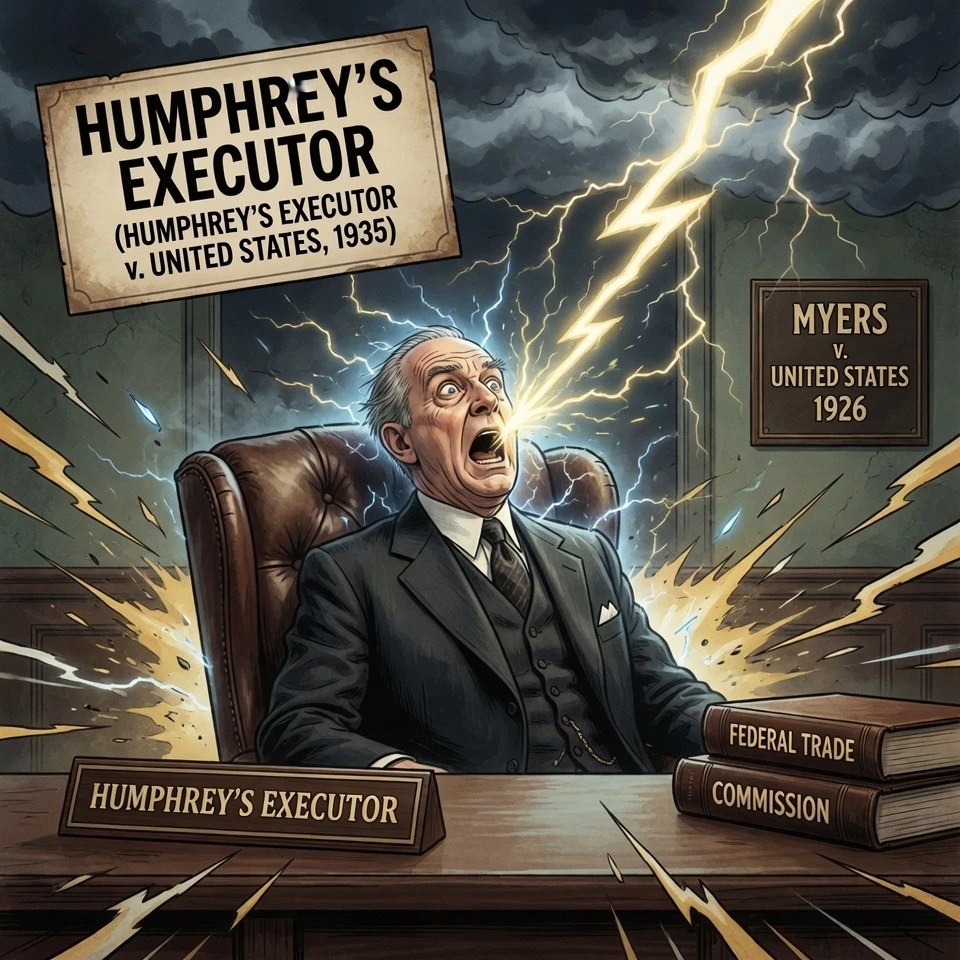
Supreme Court Zaps Ninety Years Of Deep State Humphrey S Executor Precedent by Grok is licensed under Grok xAI
Supreme Court Zaps Ninety Years of Deep State Humphrey's Executor Precedent

War Department Thingamabob Rainbows Tehran Sky, Unsettling Guards and Globalists
A Heap Of Homo Hooligan Hell Hole Rainbow Lights Shock The Sand People. Was It US? Or Enoch? Or Some Other Alien?

Bessent Pins Hugging Face Incident on OpenAI Managers, Not Agents
Bots Aren't Gay...

Austin Protesters Learn Texas Differs From Minnesota After ICE Clash
Don't Mess With Texas!

Fonzie Jumped the Shark; Fifty Years of Failure Endure
Fake And (Almost Certainly) Gay - Jewish Greaser, Mind Control And The Pop-Culture Term That Lives On...

Ukraine’s Swarm Hits Moscow Refinery as Russia Warns Retaliation
World War Three, Anyone?
Iran Issues Code 100 as Trump and Netanyahu Rush Home
Turn Up The Volume!

Trump Forms AI Force and Czar; Will Not Stifle Industry
May The Force Be With You! Superior Intelligence Is The New AI!
No First Amendment Right To A Seat In West Wing
Mockingbird Press Pissed At Being Locked Out As They Are The "Deep-State-Run-Media" - The Propaganda Arm Of The Intelligence Community Driving Mind Control - Fucking Commies! God To Hell You Sickos!