Trump’s playful rechristening of the Democrats as “Dumocrats” packs layers of linguistic mischief into a seemingly simple jab. By declaring “They’re dumb. It’s d-u-m,” he strips the word “dumb” of its final “b” and grafts the altered root onto the familiar party name, insisting that only one letter needs swapping: the “E” slips away and a “U” slides in. On the surface it’s classic Trump wordplay—short, punchy, and designed to stick in the ear—but the delivery carries the rhythm of a riddle. The audience is left wondering whether the missing “b” is mere phonetic trimming or the first breadcrumb in a larger symbolic puzzle. Every syllable feels weighted, as if the nickname itself is a cipher waiting to be unpacked by those attuned to its hidden cadence.
At the heart of the riddle sits the question of the banished “b.” What is the “b” to the beekeeper? To a beekeeper, “B” is the very essence of the hive—bee, the buzzing unit of industry, order, and occasional sting. Removing it transforms “dumb” into the blunter “dum,” as though Trump is not only insulting intellect but also excising the organized, swarming energy that the letter represents. The beekeeper tends the colony, protects the queen, harvests the honey; perhaps the “b” symbolizes the busy, collective machinery of a political machine that Trump claims to have disarmed. By discarding it, he suggests the Democrats have been rendered harmless drones—still moving, yet stripped of their coordinated bite. The metaphor lingers: a beekeeper who has smoked out the hive and left only the echo of what once hummed with purpose.
Then comes the quiet pivot: “E goes and the U comes.” What is E? In cryptic shorthand it could stand for establishment, elite, or even the echo of an old order that Trump delights in displacing. Its departure clears the stage for “U”—and the immediate follow-up, “but is that you?”—turns the substitution personal. Suddenly the listener is implicated; the “U” is no longer abstract but a direct address, an invitation to see oneself reflected in the new formation. The entire construction becomes a hall of mirrors: Dumocrats as both target and mirror, the missing “b” as neutralized threat, the swapped vowels as a quiet transfer of agency from “them” to “you.” Contemplating Dumocrats, then, is less about partisan insult than about decoding a compact parable on power, perception, and the letters that quietly reshape reality—one swapped vowel, one vanished bee at a time.
Additional ADNN Articles:

Trump’s Dumocrats Riddle: Beekeeper’s B Vanishes, E Yields to U You
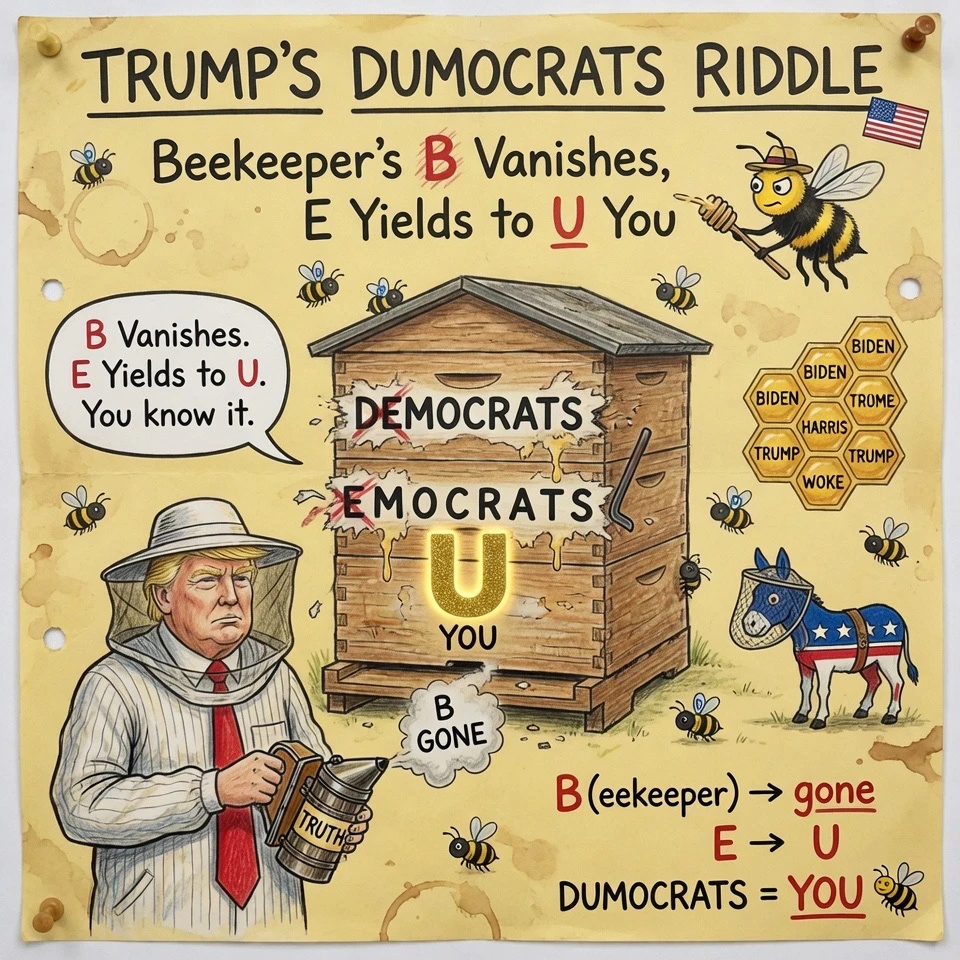
Trump S Dumocrats Riddle Beekeeper S B Vanishes E Yields To U You by Grok is licensed under Grok xAI
Trump’s Dumocrats Riddle: Beekeeper’s B Vanishes, E Yields to U You

War Department Thingamabob Rainbows Tehran Sky, Unsettling Guards and Globalists
A Heap Of Homo Hooligan Hell Hole Rainbow Lights Shock The Sand People. Was It US? Or Enoch? Or Some Other Alien?

Bessent Pins Hugging Face Incident on OpenAI Managers, Not Agents
Bots Aren't Gay...

Austin Protesters Learn Texas Differs From Minnesota After ICE Clash
Don't Mess With Texas!

Fonzie Jumped the Shark; Fifty Years of Failure Endure
Fake And (Almost Certainly) Gay - Jewish Greaser, Mind Control And The Pop-Culture Term That Lives On...

Ukraine’s Swarm Hits Moscow Refinery as Russia Warns Retaliation
World War Three, Anyone?

Iran Issues Code 100 as Trump and Netanyahu Rush Home
Turn Up The Volume!

Trump Forms AI Force and Czar; Will Not Stifle Industry
May The Force Be With You! Superior Intelligence Is The New AI!

No First Amendment Right To A Seat In West Wing
Mockingbird Press Pissed At Being Locked Out As They Are The "Deep-State-Run-Media" - The Propaganda Arm Of The Intelligence Community Driving Mind Control - Fucking Commies! God To Hell You Sickos!