Whether you hate Trump or love him, it ultimately doesn’t change the bigger picture unfolding in Washington. You can view him as a useful instrument of misdirection, drawing endless media fire and global outrage while quieter forces operate in the shadows, or as an accidental agent of chaos whose brash style upends decades of complacent foreign policy. None of that matters when you step back and examine the results. The man’s persona—polarizing as it is—has created the political cover for something far more consequential: a deliberate, disciplined strategy executed by professionals who understand that perception is the battlefield and America’s long-term dominance is the prize.
What demands genuine appreciation is the cadre of strategists embedded across the White House, Treasury, State Department, and Department of Defense. These are the unsung architects of a long game designed for America to win, not merely to score headlines or win the next news cycle. They have moved with precision and patience, leveraging every lever of economic pressure, diplomatic deal-making, and military positioning while the world remains hypnotized by spectacle. In just fifteen months, they have orchestrated a sweeping realignment of global power projection that few analysts predicted and even fewer have fully registered. This is not luck or bluster; it is statecraft at its most effective, executed by people who grasp that true strength is quiet, cumulative, and decisive.
While the world fixates on Hormuz—watching every tanker, every flare-up, every headline—the United States has quietly locked power projection over all four critical chokepoint straits: Panama, Hormuz, Malacca, and Gibraltar. Through renewed pressure on the Panama Canal, decisive naval posture in the Persian Gulf, a landmark defense pact granting expanded U.S. access near Malacca via Indonesia, and deepened military ties with Morocco securing Gibraltar’s southern flank, American influence now anchors the arteries of global commerce and energy. This is a massive realignment with profound repercussions: it reshapes supply lines, deters adversaries, and ensures that when crises erupt, the United States holds the strategic high ground. Love Trump or loathe him—the architects behind this chessboard deserve recognition for delivering a win that will echo for decades.
Additional ADNN Articles:

US Quietly Secures All Four Global Chokepoint Straits in 15 Months
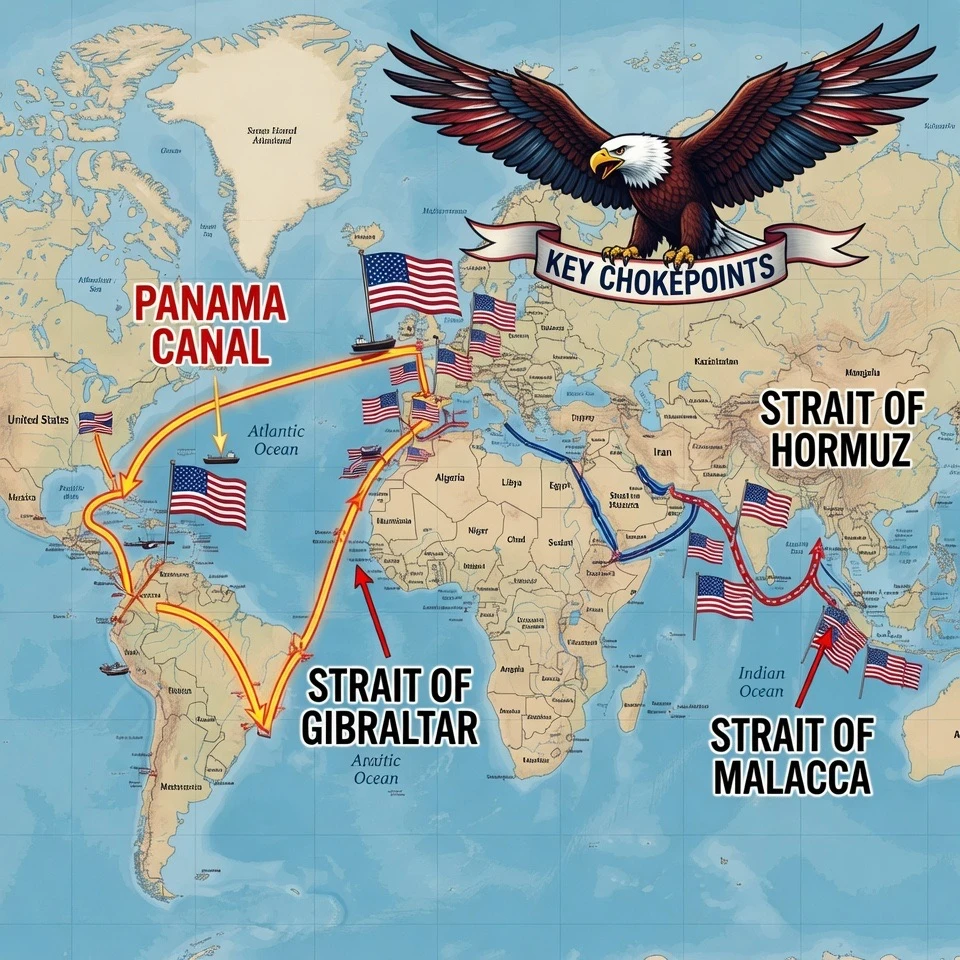
Us Quietly Secures All Four Global Chokepoint Straits In 15 Months by Grok is licensed under Grok xAI
US Quietly Secures All Four Global Chokepoint Straits in 15 Months

War Department Thingamabob Rainbows Tehran Sky, Unsettling Guards and Globalists
A Heap Of Homo Hooligan Hell Hole Rainbow Lights Shock The Sand People. Was It US? Or Enoch? Or Some Other Alien?

Bessent Pins Hugging Face Incident on OpenAI Managers, Not Agents
Bots Aren't Gay...

Austin Protesters Learn Texas Differs From Minnesota After ICE Clash
Don't Mess With Texas!

Fonzie Jumped the Shark; Fifty Years of Failure Endure
Fake And (Almost Certainly) Gay - Jewish Greaser, Mind Control And The Pop-Culture Term That Lives On...

Ukraine’s Swarm Hits Moscow Refinery as Russia Warns Retaliation
World War Three, Anyone?
Iran Issues Code 100 as Trump and Netanyahu Rush Home
Turn Up The Volume!
Trump Forms AI Force and Czar; Will Not Stifle Industry
May The Force Be With You! Superior Intelligence Is The New AI!
No First Amendment Right To A Seat In West Wing
Mockingbird Press Pissed At Being Locked Out As They Are The "Deep-State-Run-Media" - The Propaganda Arm Of The Intelligence Community Driving Mind Control - Fucking Commies! God To Hell You Sickos!