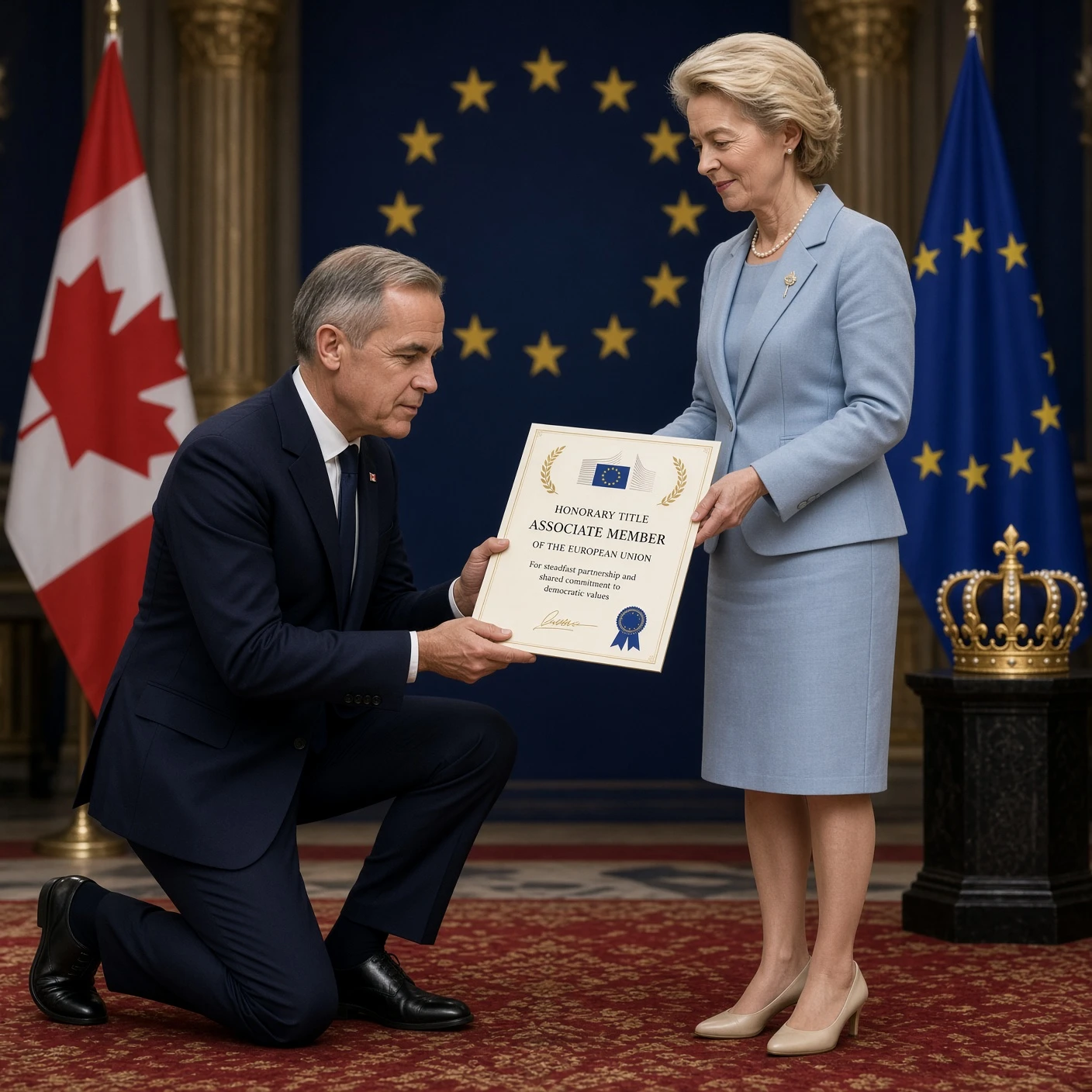
Mark Carney sat in the front row at Strasbourg and received the grand pontification he had courted. Ursula von der Leyen, addressing him as “Dear Mark,” announced that Canada should become the European Union’s first “associate member”—a rank that does not exist in the treaties, has never been defined by the member states, and was sprung on European capitals without consultation. The gesture was meant to look like escape from American gravity. It was the opposite. Carney will not accept the frank offer of becoming the fifty-first state; he will accept a title invented on the spot so that Ottawa may pose as a European satellite while remaining, in fact, a North American economy. That is not independence. It is a public confession that the Canadian governing class prefers the tutelage of Brussels to the discipline of the continent it actually inhabits.
The confession has teeth. The European Union’s regulatory architecture—precautionary product standards, carbon border mechanisms, data rules, agricultural and labor directives—does not sit easily beside the United States-Mexico-Canada Agreement. CETA already lags, still unratified by several EU states after years. Deepening that alignment into an “Alliance for the Future” covering manufacturing, defense industry, energy, minerals, and “economic security” would force Canada to become a rule-taker of one system while remaining a party to another. Trade agreements are not sentimental documents. They are schedules of compatible law. When those schedules diverge, the smaller partner is the one that must choose. Carney has chosen the pose of European association over the hard geometry of North American production. That choice does not “take Canada out” of USMCA overnight. It puts a standing contradiction at the center of Canadian commercial policy and invites every subsequent American administration to treat Ottawa as a jurisdiction that has begun to look elsewhere.
Alberta will notice first. A province whose wealth is energy and whose markets run south does not need a lecture from Strasbourg about climate and supply chains. Secession talk that once sounded theatrical becomes a calculation once Ottawa advertises that its future regulatory north star is a continent three thousand miles away, already straining under demographic and fiscal load. Europe’s present course—open frontiers, declining cohesion, and the slow displacement of the historic nations that built the Union—is not a model a resource hinterland will volunteer to join. The longer Carney pursues a status that Brussels itself cannot define, the more the western provinces will treat Confederation as a temporary arrangement. Geography remains what it is. Over decades the continent sorts itself. Canada’s governing class may prefer European ceremony. The land and the trade routes will prefer the American order that already surrounds them.
Additional ADNN Articles:
Canada’s $40B Arctic Defense: Futile EU Bid vs. US Integration
Carney’s Trade Sabotage Cannot Halt America’s Claim on Canada
Canada Truly Belongs in the Union as America’s Fifty-First State
Alberta Secessionists Gather Enough Signatures to Secede and Join USA

Carney Courts Phantom EU Rank and Gifts MAGA Canada's Split
Carney Courts Phantom EU Rank and Gifts MAGA Canada's Split
Fed Hikes Rates, Proving Money Power Still Defies Voters
The System Controls You! Dead Or Alive...
The United States Will Never Be an Effective Altruist Country
Real And Straight. Always. Try Your Weak Communism Elsewhere. Or Better Yet...Go To Hell!
First Woman Primate Honors Bin Laden’s Champion; Wife Erased Beside Him.
Clown World! - Dark Clowns!
Xi Hospital Rumor Exposes a China Unable to Succeed Him
Chicom Is Awhirl With Anticipation...Who Poisoned XI? Imagine Elaine And Mitch Together?? Sickening...

Saudi Warns Mecca a Red Line After Houthi Drone Intercepted
Turn The Place To Glass Already!!!
Patel Holds Senators for Hours, Declining Their Ritual Script
Sacred Cows?? I'll Show You The Real Shit! Says The Pajeet Patel! Truth Bombs Left And Right!
Anthropic Wants Woke Altruistic Communists Regulating Every Other AI Firm
Physiognomy, Politics And Psychosis + Liberal, Leftist And Losers = Bad For Humanity, Thus Slated For Termination By The AI. You'reTerminated!
Court Blocks Mail Ballot Screens as Midterm Ballots Fly Unchecked
Elections Are Fake And Gay!