The Pentagon has quietly rewritten the rules of military survival under an initiative called FORTRESS. Major installations across the continental United States are now expected to keep the lights on, the aircraft flying, and the command posts functioning for ninety days without drawing power, water, fuel, or spare parts from the civilian grid or the global supply chain. Documents reviewed by Fox News describe microgrids, portable nuclear reactors, and deep reserves of ammunition, critical minerals, and medical stores—the practical recognition that a serious war, whether opened by cyber sabotage or long-range strike, could sever the bases from the very infrastructure they once took for granted. At the same moment former FBI Deputy Director Dan Bongino has told ordinary households to stop treating preparedness as a hobby and start treating it as a duty: three days of food and water at minimum, an emergency radio, filtration tablets, batteries. Britain has issued the same counsel to its citizens; Japan is preparing to do likewise. The official line remains measured. The implication is not.
What is unfolding is the delayed bill for thirty years of just-in-time logistics, offshored industry, and the quiet assumption that American power would never again have to operate while the lights failed at home. Chinese actors have already mapped and probed the civilian power grid, the ports, and the undersea cables; Iranian and Russian proxies have shown they can disrupt shipping and energy routes when it suits them. Secretary of War Pete Hegseth has said the quiet part aloud: power itself is now combat. A military that cannot keep its own bases running when the commercial grid is dark is a military that has outsourced its survival to adversaries. FORTRESS is therefore less a prophecy of imminent apocalypse than a correction of strategic negligence. It restores the elementary requirement that the forces charged with defending the Republic must be able to function even if the Republic’s civilian systems are temporarily blinded. The same logic, applied one level down, is what Bongino is pressing on the public: the neighbor who has nothing extra will not share it when the shelves empty and the pumps stop.
What is coming is not a single, scripted catastrophe so much as the ordinary friction of great-power competition made sharper by technological fragility. A multi-front crisis—whether in the Western Pacific, the Middle East, or both—could stretch supply lines, invite cyber and drone attacks on critical infrastructure, and leave households without the convenience they have treated as permanent. The military’s ninety-day standard is the institutional admission that such interruptions are now plausible; the civilian three-day recommendation is the modest counterpart that governments still feel free to voice. Preparedness is not panic. It is the older American habit of assuming that the state will prioritize the defense of the nation over the comfort of any single household, and that free men and women therefore keep their own stores, their own tools, and their own plans. Fortress America begins with bases that can stand alone. It continues with households that do not expect the next truck to arrive on schedule. The distinction between those two efforts is smaller than the comfort of ordinary life has led most people to believe.
Additional ADNN Articles:
Doomsday Plane Circles Offutt Amid Iran Tensions
Hegseth Cuts the Brass, Raises a Fortress, Commissions the Future
Iran Issues Code 100 as Trump and Netanyahu Rush Home
Gen. McKenzie: US Planned Iran Ground Raids for Years

Pentagon Prepares Bases for Ninety Days Without Power or Supplies
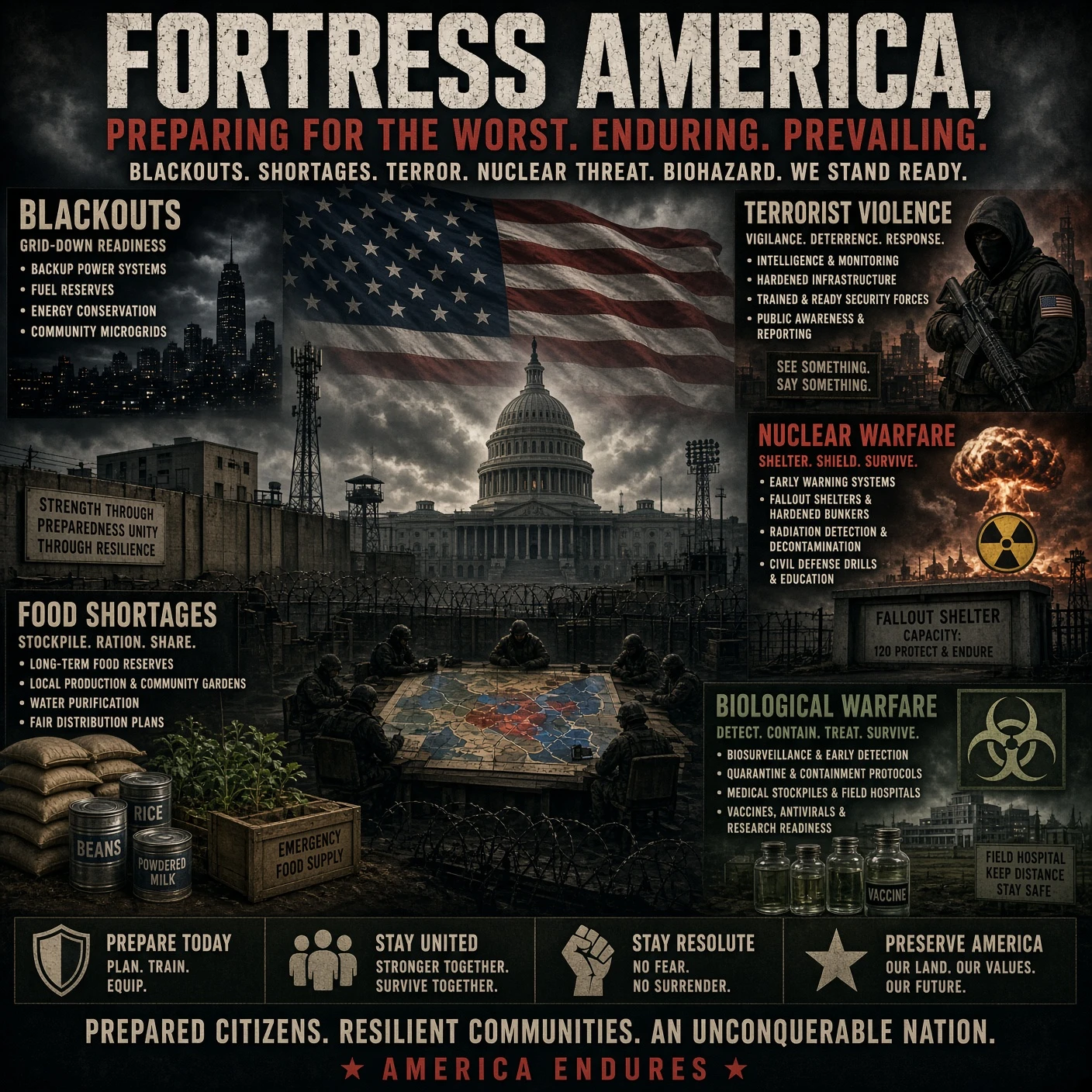
Pentagon Prepares Bases For Ninety Days Without Power Or Supplies by Grok is licensed under Grok xAI
|
Pentagon Prepares Bases for Ninety Days Without Power or Supplies

American Output Accelerates to 3.4 Percent as Price Pressures Recede
Golden Age Incoming!
Military Deploys Avenger Missile Systems Near Trump Palm Beach Airport
Protecting Dear Leader Is Priority!

North Korean Operators Drain Six Billion From Binance in Hours
The Cartels Are In Control. Don't Believe The Hype...




Netanyahu Bloc Leads as Ballots Contradict Exit Poll Predictions.
Jew Win Some! Jew Lose Some...Jew Know?