The recent decision of the Supreme Court in Trump v. Barbara, by embedding a broad construction of birthright citizenship firmly within the text and original understanding of the Fourteenth Amendment’s Citizenship Clause, has exposed the limits of correction through the ordinary channels of national politics. Chief Justice Roberts’s opinion for the Court treated the phrase “subject to the jurisdiction thereof” as settled by text, history, and precedent in a manner that leaves little room for executive or legislative adjustment short of formal amendment. In so doing, the ruling has illustrated how judicial entrenchment of a single constitutional provision can place large questions of sovereignty, immigration, and federal character beyond the reach of elections or ordinary legislation, thereby sharpening the case for recourse to the Article V convention process that the Framers placed in the hands of the states.
This outcome has given renewed coherence to long-standing arguments for convening the states to consider the repeal of amendments whose practical consequences have diverged from, or actively undermined, the constitutional design they were said to perfect. The Fourteenth Amendment, through its later judicial elaboration, has supplied the doctrinal foundation for expansive national administrative power and a reordering of federal-state relations that many original understandings of the Union never contemplated. The Sixteenth removed the structural restraint on unapportioned direct taxation and thereby enabled the permanent fiscal centralization of the twentieth century. The Seventeenth altered the Senate’s role as a representative of state governments, weakening one of the Constitution’s principal mechanisms for preserving federal balance. The Nineteenth, by expanding the electorate without corresponding adjustments to the deliberative character of republican institutions, participated in a broader transformation of the political order whose long-term effects on civic capacity and institutional restraint continue to be debated. A convention called by the states would allow these provisions to be examined and, where judged necessary, repealed or revised through the deliberate action of three-fourths of the states rather than through the self-interested ratification of a Congress that has grown comfortable with the powers those amendments conferred.
Such a convention could simultaneously advance affirmative reforms that the present national legislature has shown no capacity to originate or ratify. Amendments securing the right of citizens to grow, raise, and sell food free from arbitrary federal prohibition or licensing would restore a basic dimension of economic self-sufficiency against regulatory regimes that treat ordinary production as a privilege to be dispensed. Provisions affirming a right to be free from systematic government surveillance would bring the Fourth Amendment’s original guarantees into alignment with contemporary technology rather than leaving privacy to be defined by administrative convenience. A structural separation of education and state, confining federal authority to the bare minimum and returning primary responsibility to families and localities, would counteract the centralization that has produced curricula and standards detached from the varied circumstances of American communities. These and kindred measures, advanced through the state-initiated process of Article V, offer a constitutional path for restoring equilibrium between individual liberty, local authority, and national power that the corrupted incentives of the current House and Senate render unattainable under the ordinary amendment procedures.
Additional ADNN Articles:
Supreme Court Entrenches Poison Pill Of Unpopular 14th Amendment
SCOTUS Dodges Birthright Citizenship Crisis With Insufferable Law Ramble
Five Justices Mercurial Whims Decide Fate Of American Citizenship
MacDill Bomb Plot Exposes Birthright Citizenship Danger

SCOTUS Codifies Birthright Citizenship, Sparking States Convention for Amendment Repeals
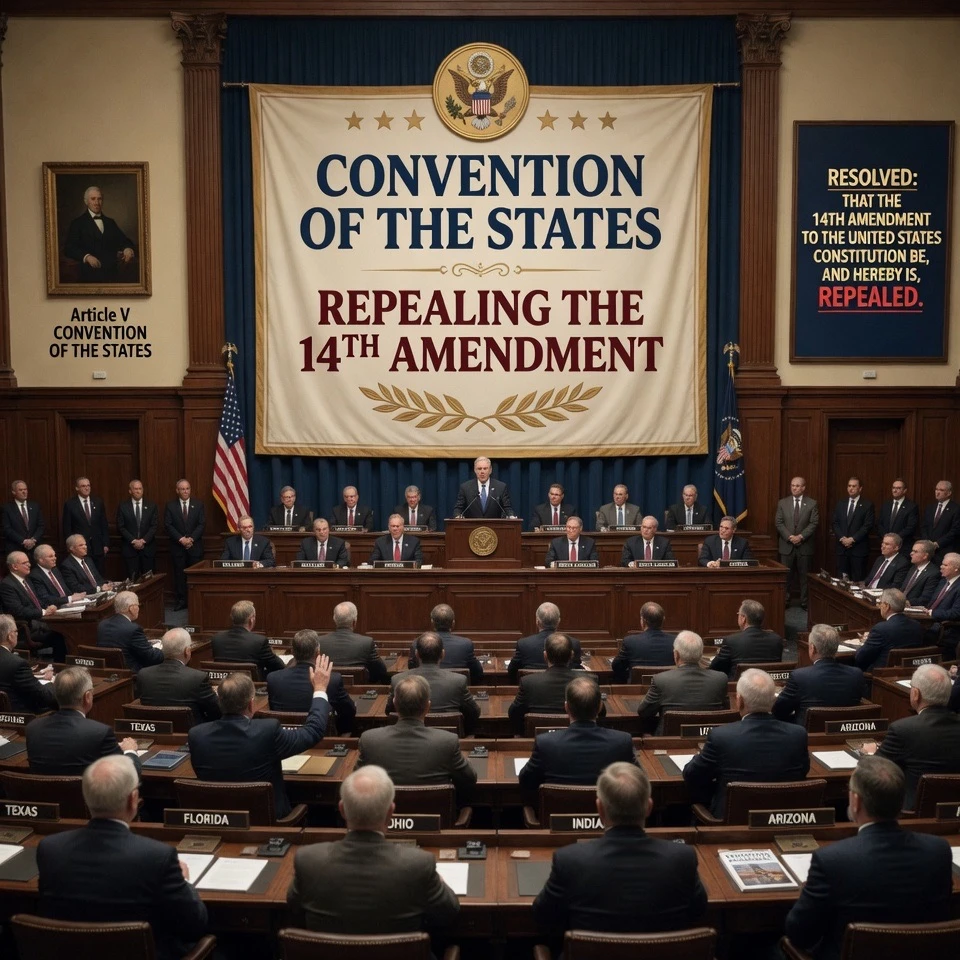
Scotus Codifies Birthright Citizenship Sparking States Convention For Amendment Repeals by Grok is licensed under Grok xAI
SCOTUS Codifies Birthright Citizenship, Sparking States Convention for Amendment Repeals

DOJ Filing Names Omar as Ilhan Nur Said Elmi, Alias Omar
Gotcha Bitch!

Virginia Senate Leader Surrendered in RICO Drug Trafficking Conspiracy
It Just Writes Itself. Niggers...


Musk Warns Democrats: Live By The Sword, Die By The Sword
There Will Be Blood!

White House Reveals Middle Class Paid Half Life for Fraudsters
Fraud Is Real! Justice Is Coming...Trust Trump!

Europe’s Women Cradle Dogs Where Their Aborted Children Should Be
European Irony...Can't Live With 'Em, Can't Kill 'Em And Can't Reproduce With 'Em.

Retired Admirals and Bureaucrats Caught Defining When America Is Illegitimate
TDS Is Real! You Know What Else Is Real...Treason & Sedition! Time For Heads To Roll!

Descendants of Redskins Logo Chief Demand Trump Restore the Name
Hail To The Redskins! Hail Trump! Hail Redskin Nation! Heal America!