The Trump administration’s decision to post 248 internal USAID documents on the agency’s own website is less a bureaucratic courtesy than a calculated reopening of the books. Memos, emails, and meeting notes from the previous era show the agency in routine contact with Meta, YouTube, and Google over the removal or demotion of foreign content labeled “disinformation.” These were not abstract policy discussions. They record concrete requests to take down posts, suspend pages, and coordinate with platforms on what foreign audiences should see. The files place USAID not as a passive funder of democracy promotion but as an active participant in content decisions that previous administrations preferred to keep offstage.
The same release throws light on where the money went. It records $32.45 million directed to the Organized Crime and Corruption Reporting Project, an organization whose reporting has long been presented as independent while relying heavily on U.S. government support. Separate government transaction records show $8.2 million flowing to Politico, almost entirely in the form of institutional subscriptions rather than grants, yet still illustrating how taxpayer dollars underwrote the information diet of the policy class. Parallel to these media channels sits the far larger sum of roughly $26 billion in direct budget support to Ukraine, routed through World Bank trust funds with USAID as the principal steward. The documents and the ledgers together sketch an apparatus in which foreign assistance, investigative journalism, and content moderation operated as interlocking instruments rather than separate domains.
What the Trump team has done is reverse the usual sequence. Instead of defending the agency’s former practices, it has placed the primary materials in public view and invited the country to judge them. The files do not resolve every dispute over motive or effect; they simply remove the claim that the work was too sensitive or too technical for ordinary scrutiny. In an administration already engaged in dismantling the old USAID structure, the publication functions as both inventory and indictment: evidence that foreign-aid dollars, media partnerships, and platform relationships had been fused into a single project of narrative management, now open to the inspection it was never designed to survive.
Additional ADNN Articles:
USAID Defunded: 7 “Far-Right” Latin Wins Expose Aid Myth
USAID’s end bankrupted the clients and restored the country.
Domestic Agencies Orchestrate Systemic Outages for Deep State Reckoning
White House Reveals Middle Class Paid Half Life for Fraudsters

Trump Releases 248 USAID Files Exposing Tech Disinformation and Billions in Aid
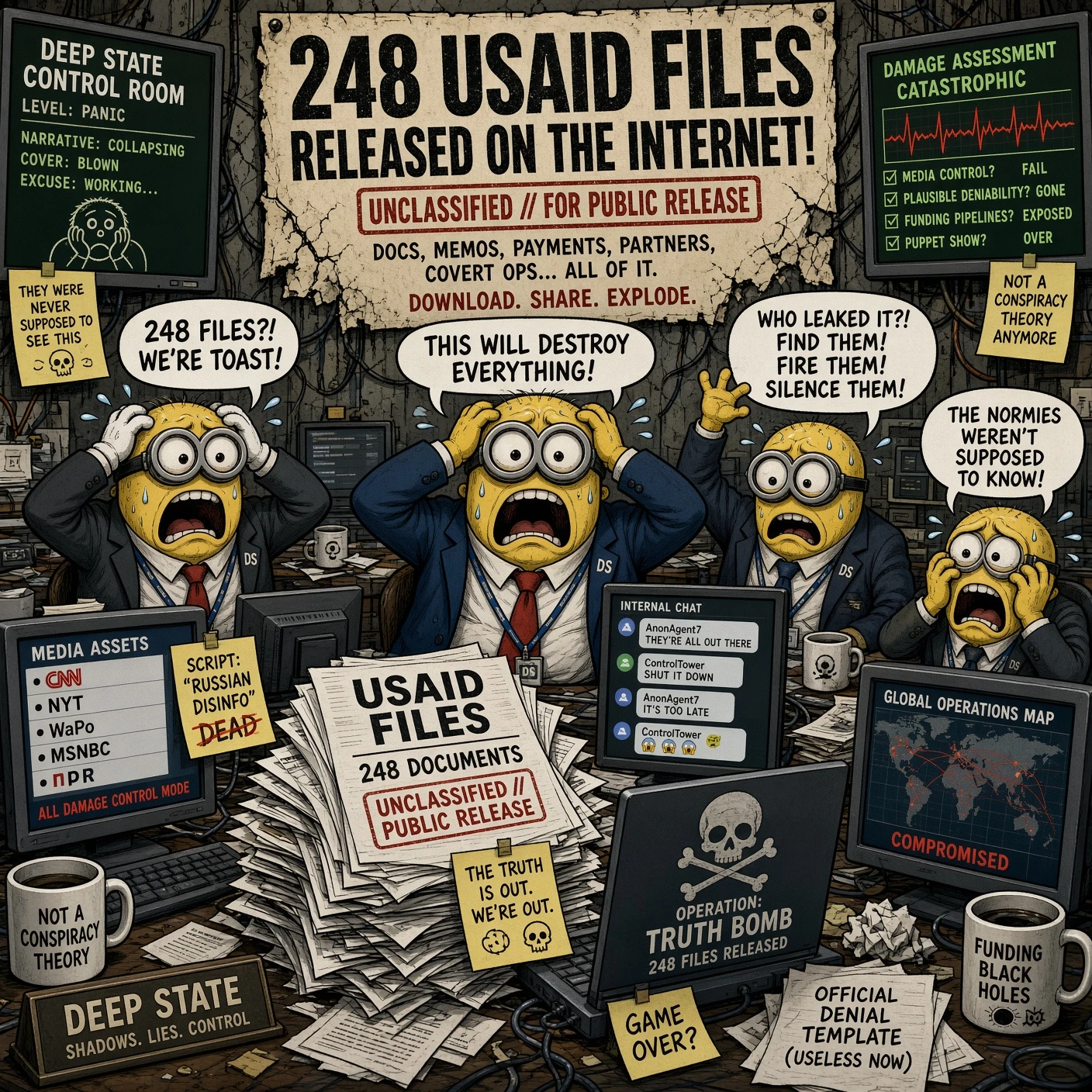
Trump Releases 248 Usaid Files Exposing Tech Disinformation And Billions In Aid by Grok is licensed under Grok xAI
|
Trump Releases 248 USAID Files Exposing Tech Disinformation and Billions in Aid

Trump Thanksgiving Post Exposes GDP Sabotage and Deep State Resistance
Pilgrim's Post! The Boss Is In Charge!
Attackers Breach Air Force Cloud Control Plane Amid Agency Disruptions
Spy War Ongoing...White Hats Vs. Black Hats!

NFL Thanksgiving Games End in Historic Final-Second Scores Mirroring Odds
NFL = Nigger Faggot League Or Numbers Fake League...But It Sure Is Entertaining! Bread And Circus!
Trump Tariffs Force China Vietnam India Toward Immediate Trade Deals
Art Of The Deal...Asia Pacific Style.


Steelers Cut Rodgers After Interview Nukes McCarthy And Liberal Rooneys
The Truth Teller - Being A Dragon Slayer Is Lonely Business! Burn It Down!

Macy’s Centennial Parade Postponed First Time in Its History
Talk About Letting The Air Out Of The Balloon!

Vicious Fight Over Huang Signals Rise of Sovereign Full Stack
Dear Jensen, You can’t eat your cake and have it too. - Love, Ted