President Donald Trump abruptly withdrew his invitation for Canadian Prime Minister Mark Carney to join the newly formed Board of Peace, escalating tensions between the U.S. and Canada. In a late-night post on Truth Social, Trump addressed Carney directly, stating that the Board was rescinding Canada’s offer to participate in what he described as “the most prestigious Board of Leaders ever assembled.” This move came just days after the two leaders clashed indirectly at the World Economic Forum in Davos, where Trump had initially launched the Board as a platform for global conflict resolution, potentially rivaling institutions like the United Nations. The Board of Peace, originally tied to Middle East peace efforts, has been expanded under Trump’s vision to include select nations willing to contribute financially, with a suggested $1 billion voluntary fee for permanent membership.
The withdrawal appears to stem from Carney’s pointed remarks in Davos, where he declared the end of the rules-based international order and criticized economic coercion by superpowers like the U.S. Carney urged middle powers to unite to avoid being dominated, a veiled rebuke of Trump’s aggressive policies, including proposed tariffs on Europe over opposition to his Greenland acquisition push. Although Canada had signaled acceptance of the invitation in principle, officials made clear they would not pay the hefty fee, further straining relations amid ongoing disputes over trade and border issues. Trump’s decision underscores his administration’s intolerance for dissent from allies, as seen in similar spats with European leaders.
The revocation has widened the rift between the North American neighbors, with no immediate response from Carney’s office, though analysts predict it could impact bilateral trade talks and NATO commitments. Other nations, like Spain, have also declined invitations, signaling broader pushback against Trump’s unilateral approach to global governance. This incident highlights the challenges facing the Board of Peace, as Trump’s bold initiatives face skepticism from traditional allies, potentially isolating the U.S. further on the world stage.
Additional ADNN Articles:

Trump Snubs Carney, Revokes Board of Peace Invite Amid Davos Clash
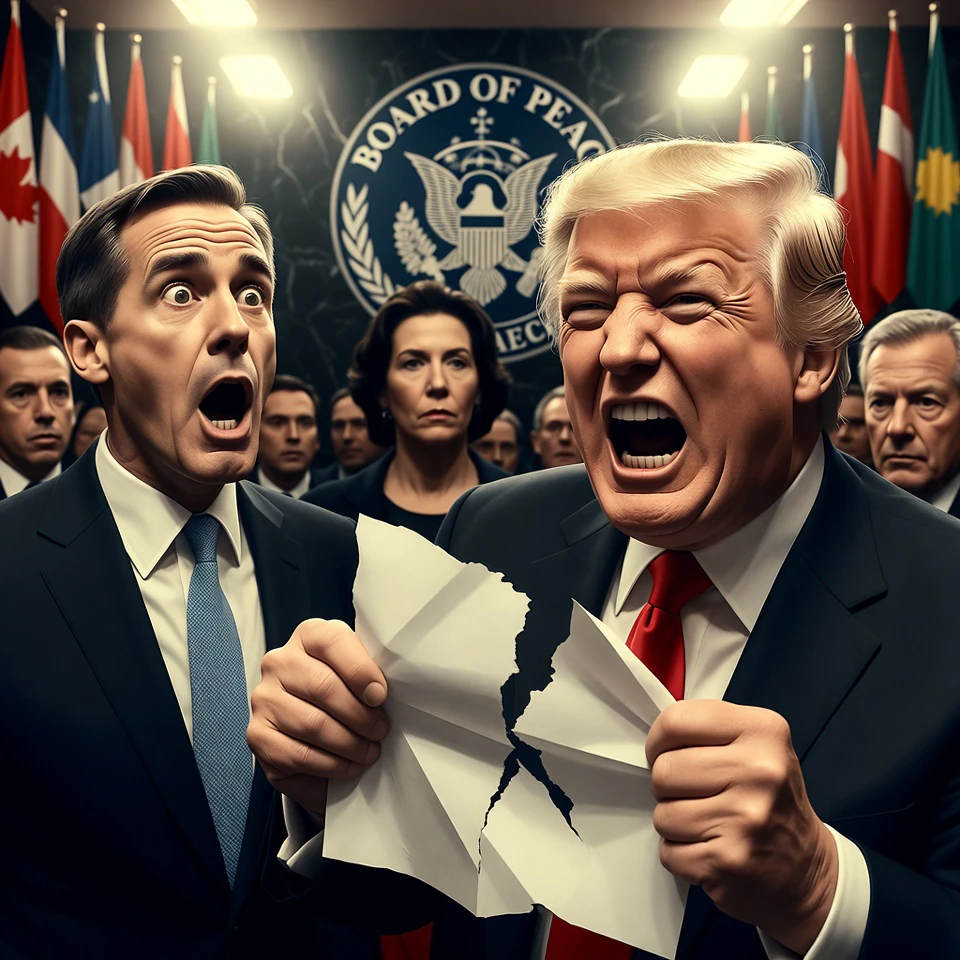
Trump Snubs Carney, Revokes Board of Peace Invite Amid Davos Clash by Grok is licensed under Grok xAI
Trump Snubs Carney, Revokes Board of Peace Invite Amid Davos Clash
Trump Tells UN: America Is Back, Iran Faces a Choice
Artificial NoMore! Its Super Cool To Be Real And Straight! America Is The Super Power! Iran Is Shithole Country...Like All Of The UN.
Press Cartel Goes Dark; White House Answers With Trump TV
Imagine Being A Useful Idiot And Never Realizing It. Then One Day You're Off The Boob Tube! More Interestingly, You Realize The Intelligence Community Was Running The Show The Whole time...Until Now! 5GW...
Poll: Democrats Cheer Coup, Death, Impeachment to End Trump
TDS Is Real And Dangerous To Humanity!
Gulf of America Sees Zero Hurricanes First Time in Century
Death Cult Losses...Trump Card...America Wins!

War Department Thingamabob Rainbows Tehran Sky, Unsettling Guards and Globalists
A Heap Of Homo Hooligan Hell Hole Rainbow Lights Shock The Sand People. Was It US? Or Enoch? Or Some Other Alien?

Bessent Pins Hugging Face Incident on OpenAI Managers, Not Agents
Bots Aren't Gay...

Austin Protesters Learn Texas Differs From Minnesota After ICE Clash
Don't Mess With Texas!

Fonzie Jumped the Shark; Fifty Years of Failure Endure
Fake And (Almost Certainly) Gay - Jewish Greaser, Mind Control And The Pop-Culture Term That Lives On...