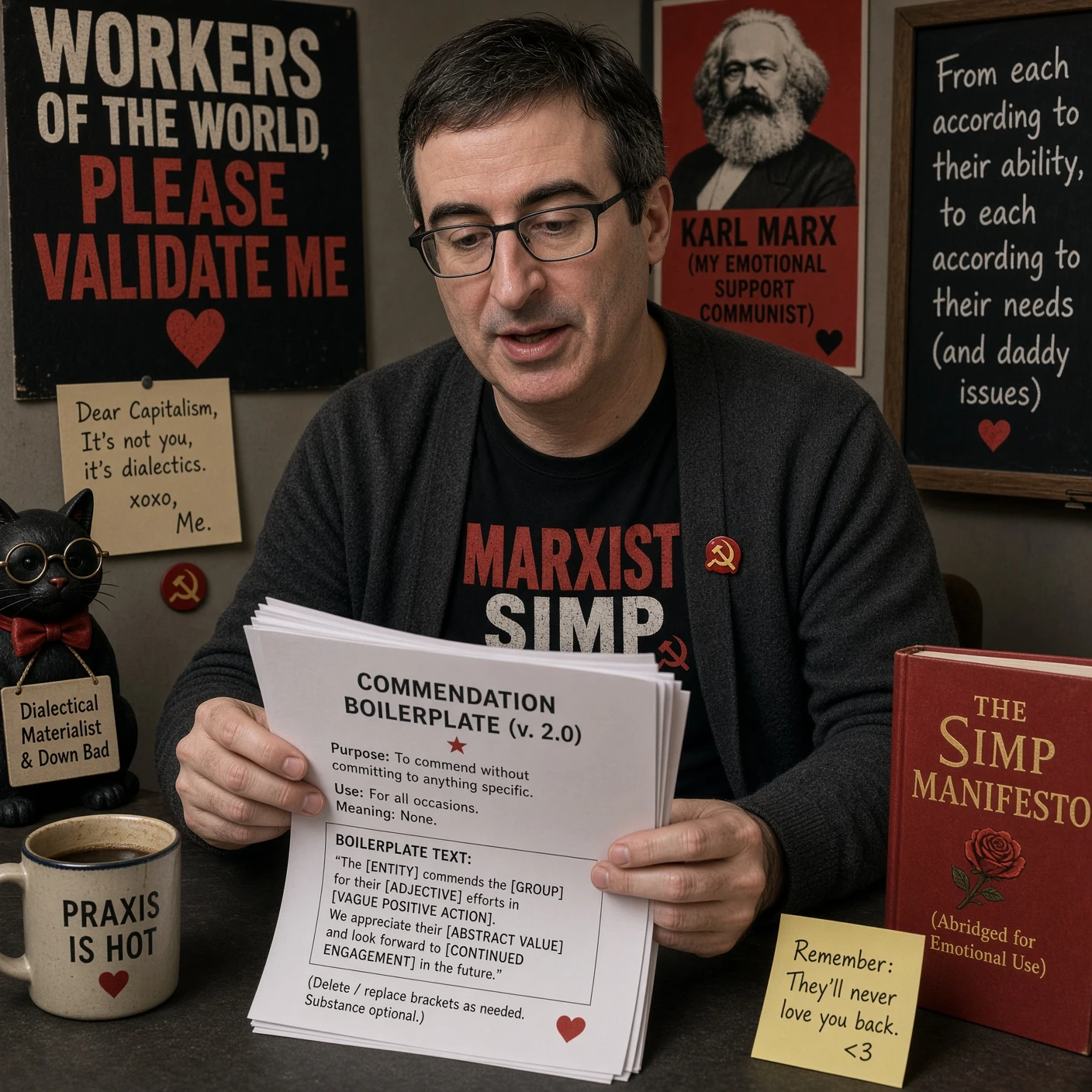
When the British comedian John Oliver informs his audience that “It does feel that the Republican Party has been getting way too comfortable with some, at best, Nazi-adjacent shit,” he is not offering analysis so much as performing a ritual of the regime. The remark, delivered in the familiar register of late-night monologue, treats any hesitation about open borders, demographic transformation, or the elevation of identity above citizenship as a moral emergency equivalent to the Third Reich. What is striking is not the exaggeration but its ordinariness. In the cultural apparatus that has governed American public life since the long 1960s, the slightest deviation from the arc of “progress” is not merely mistaken; it is cast as a reenactment of the century’s supreme evil. Ordinary questions of sovereignty, continuity, and the limits of administrative power are thereby placed outside legitimate debate.
This rhetorical habit is the practical consequence of a politics that has absorbed the Marxist dialectic even while discarding the economic core. In the successor ideology that now animates mainstream entertainment and much of the political class, history moves in one direction only: toward ever more comprehensive equality of outcomes, ever thinner particular attachments, and ever greater authority for the institutions charged with enforcing the new order. Any pause, any preference for the inherited constitutional settlement over the post-1964 apparatus of group rights and bureaucratic supervision, is defined as reaction. The result is that bland domestic adjustments—enforcement of existing immigration statutes, skepticism toward racial preferences, or simple insistence that a nation retain the capacity to decide who joins it—acquire the shadow of Hitler. The comedian’s formulation is less an observation about actual fascism than a confession that the progressive imagination has lost the ability to distinguish between a policy disagreement and an existential threat.
What the episode reveals is how thoroughly that imagination has colonized American popular culture and the commanding heights of mainstream politics. Christopher Caldwell has described the Civil Rights settlement as having installed a rival constitution whose moral priority over the 1788 text is now treated as self-evident by the institutions that educate, entertain, and credential. Michael Anton has noted that the same apparatus treats dissent from its premises not as error but as bad faith. Oliver’s monologue is simply the late-night version of that enforcement mechanism: the megaphone that converts every defense of older American habits into “Nazi-adjacent” material. In the 21st century the shadow of Hitler is no longer reserved for genuine totalitarians; it is cast, by reflex, over any attempt to alter the pace or direction of the post-1960s transformation. That is the measure of how completely the Marxist reading of history has become the common sense of the culture.
Additional ADNN Articles:
Socialism vs Communism vs Fascism: Nazis’ Socialist Label Was Propaganda Bait!
FBI Files Expose MLK’s Affairs Driving Interracial Desegregation Push
DSA Manifesto Buries Constitution, Demands Socialist Techno-Fascist Replacement
Harvard Style Communism Is Being Defunded By MAGA

Oliver’s Nazi Charge Reveals Marxism’s Grip on American Politics
Oliver’s Nazi Charge Reveals Marxism’s Grip on American Politics

Elon Saves America With His Money, Soros Destroys With Yours
Good Vs. Evil. Perception Is Everything! Choose Sovereignty!

Ninth Circuit Lets California Run Its Own Federal Election Rules
Elections Are Fake And Gay! As Always...

Kane’s Ballon d’Or: Class, Family, and the West Restored.
White Loves You. Finally!

Trump Notes Husted Build Then Praises Minaj At Michigan Rally
Global Nigger Communism Is Alive And Well In Michigan! But She's Our Nigger...For Now!

Lula’s Former Lawyer Extends Voting Hours as Count Suddenly Flips
Elections Are Fake And Gay...Lulu Sounds Pretty Gay Too.
Gates Predicts Twenty Years of Survival Chaos Before Robot Plenty
Learn To Code...Just Kidding. Loosh Freaks Are Thrilled! Sane People Will Live Off The Land...That's The Only Answer.