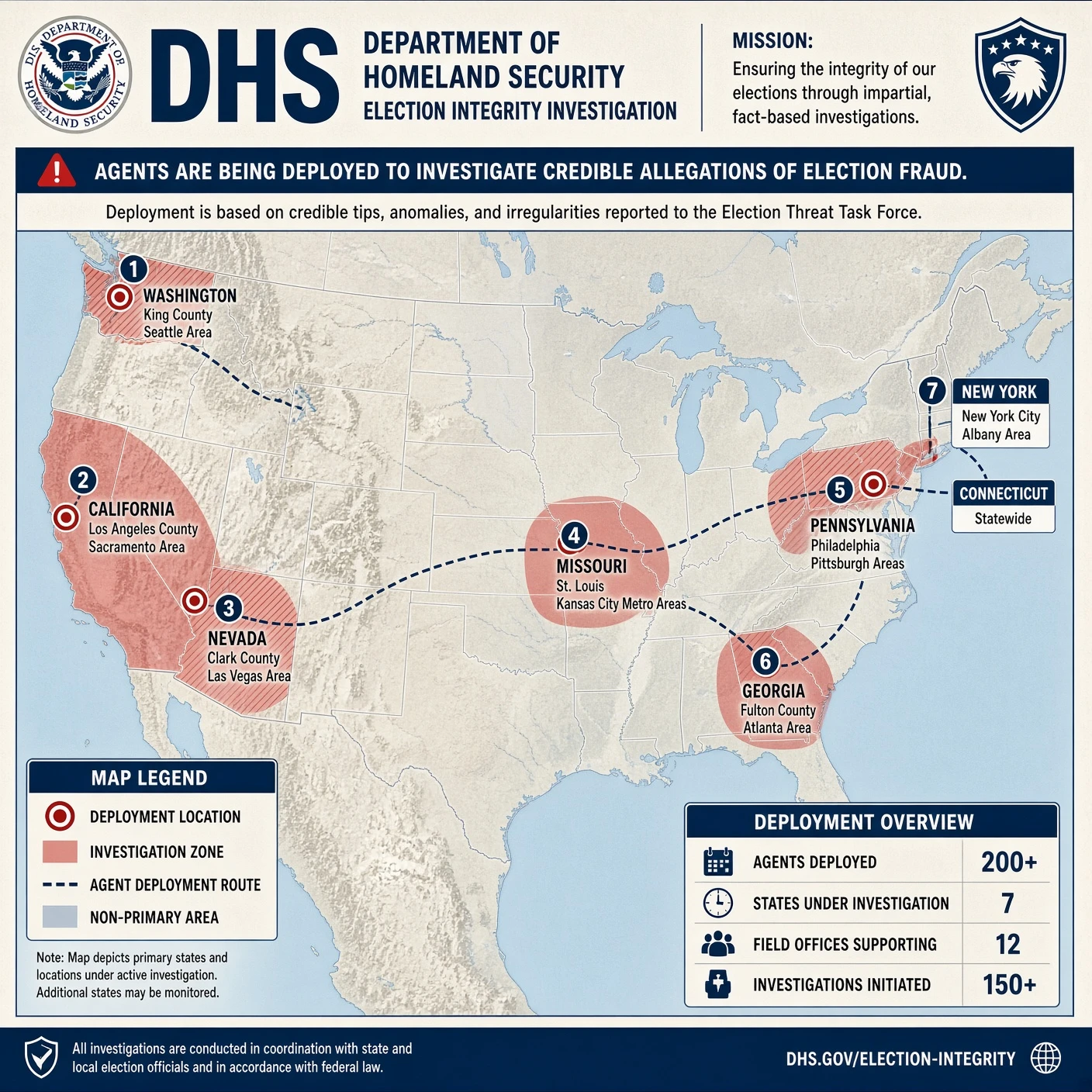
President Trump has directed the Department of Homeland Security to open a coordinated investigative surge against voter fraud, with Homeland Security Investigations offices in Washington, Wisconsin, Missouri, Georgia, California, Pennsylvania, Nevada, New York, and Connecticut set to pursue leads, conduct interviews, and move cases toward prosecution in the weeks before the midterms. The timing is not accidental. Republicans face a difficult map and an opposition that has spent years treating the franchise as an administrative convenience rather than the exclusive right of citizens. What the administration is doing is elementary: it is asking whether the rolls contain people who have no legal claim to cast a ballot and whether those who registered or voted unlawfully will face consequences. That this is treated as a scandal by the same institutions that spent a decade insisting the problem was imaginary tells you more about those institutions than about the law.
Citizenship is the boundary of the political community. A republic that cannot say who belongs to it cannot say who may govern it. The post-1960s settlement treated that boundary as an embarrassment—something to be managed, papered over, or dissolved in the name of inclusion. The result was a system in which registration became easy, verification became suspect, and any attempt to distinguish citizen from noncitizen was denounced as exclusion. The present effort is a belated correction. It does not require one to believe that every flagged name is a proven crime. It requires only that the government treat the prohibition on noncitizen voting as something other than a dead letter, and that states which refuse to clean their lists be pressed rather than indulged.
The coming midterms will test whether that correction can survive contact with the political class that benefits from the old arrangement. Swing-state machines, urban registration mills, and the donor-funded legal apparatus that exists to freeze the status quo will call the investigations intimidation. They will be half right. The point of enforcement is to deter. A country that will not police its own elections will not remain a country of self-governing citizens; it will become a territory administered by those who can move bodies across the line and call the result democracy. The nine-state sweep is a first cut at restoring the distinction the Constitution presupposes and that recent practice has tried to forget.
Additional ADNN Articles:
Judge Again Halts Trump Mail Voting Order Ahead of Midterms
Supreme Court Clears Way for Trump's Mail Ballot Fraud Protections
Prakash Fake Poll Proved Manufactured Numbers Can Decide Close Contests
ICE Probe of Congresswoman Omar Signals Shape Up or Ship Out

Trump Orders DHS Voter Fraud Crackdown Across Nine Battleground States
Trump Orders Dhs Voter Fraud Crackdown Across Nine Battleground States by Grok is licensed under Grok xAI
Trump Orders DHS Voter Fraud Crackdown Across Nine Battleground States
White House Reveals Middle Class Paid Half Life for Fraudsters
Fraud Is Real! Justice Is Coming...Trust Trump!

Europe’s Women Cradle Dogs Where Their Aborted Children Should Be
European Irony...Can't Live With 'Em, Can't Kill 'Em And Can't Reproduce With 'Em.
Retired Admirals and Bureaucrats Caught Defining When America Is Illegitimate
TDS Is Real! You Know What Else Is Real...Treason & Sedition! Time For Heads To Roll!

Descendants of Redskins Logo Chief Demand Trump Restore the Name
Hail To The Redskins! Hail Trump! Hail Redskin Nation! Heal America!
Trump Defies Captured Senate, Prioritizes Peace and Trade With Russia
Dictate This! Congress Is Feckless, Weak And Whacked! Trump Is In Charge! We Think...Who Knows??? Aliens, Simulation, Fate?
Alberta Remains Canadian, Forcing Full Scale American Invasion and Annexation
The War Of Southern Aggression Is Coming! Prepare Thyself!
Nationalist Compact Replaces Debt Slavery as Senate Fate Decides Shift
Set Yourself Free!
Former CIA Governor Installs Soros Operative in Virginia Congress Seat
White Hats Vs. Black Hats...Spy War Continues. Question Is Who They Really Working For? Time Will Tell!