The House dispatched the latest continuing resolution by a vote of 370 to 48, a margin so lopsided it announced what everyone already knew: neither party intends to risk a shutdown on the eve of the midterms. The measure simply extends current outlays through December 11, leaving the real appropriations fight for the lame-duck session when the electoral arithmetic will have clarified who still possesses leverage. Speaker Johnson and the appropriators presented the bill as prudence; it is more accurately a confession that Congress has again chosen delay over discipline. The few dozen dissenters on each side were not so much fiscal hawks as members who objected to particular riders—hemp, grant rules, border-transfer language—while remaining silent on the larger fact that the federal government continues to spend as if the bond market were a captive audience.
Bond vigilantes have historically been the market’s last remaining adult in the room, the investors who refuse to finance endless deficits once yields no longer compensate for inflation and political risk. Their patience with Washington’s loose purse strings is already thin. For most countries such profligacy would be an existential problem: creditors would demand higher rates, a weaker currency, and eventually a restructuring. The arithmetic is not mysterious. A government that cannot produce a regular budget and must instead roll forward last year’s spending by continuing resolution is broadcasting that it has no plan to live within its means. In an ordinary nation that signal would already have produced a crisis of confidence.
America is not an ordinary nation. It possesses a nuclear arsenal of unmatched size and sophistication and a military whose annual cost now approaches a trillion dollars. Those instruments are not merely tools of foreign policy; they are the ultimate collateral. No creditor can collect a debt from a sovereign that retains the capacity to make collection physically impossible. The dollar remains the reserve currency not because Congress has earned the world’s trust through fiscal rectitude, but because the alternative—attempting to enforce claims against a nuclear-armed superpower—is unthinkable. That is the unstated premise of every continuing resolution. The markets may grumble, the vigilantes may sell, yet they still buy Treasuries because they understand that the United States is the only debtor that can, if pressed, simply refuse to be collected upon. The arrangement is unstable, but it is also, for the moment, unchallenged.
Additional ADNN Articles:
$40T Debt Unpayable: Hyperinflation Default Coming, Hard Assets Only Survive
Bond Yields Soar Amid Deficits AI Inflation but America Prevails
Cut $1.5T Fraud, Zero Income Tax for Under $500K Earners
Congress Seals $1.2T Funding Deal, Debunking Trump Totalitarianism Fears as Baseless

Congress Extends Spending Because No Creditor Can Collect Nuclear Debt
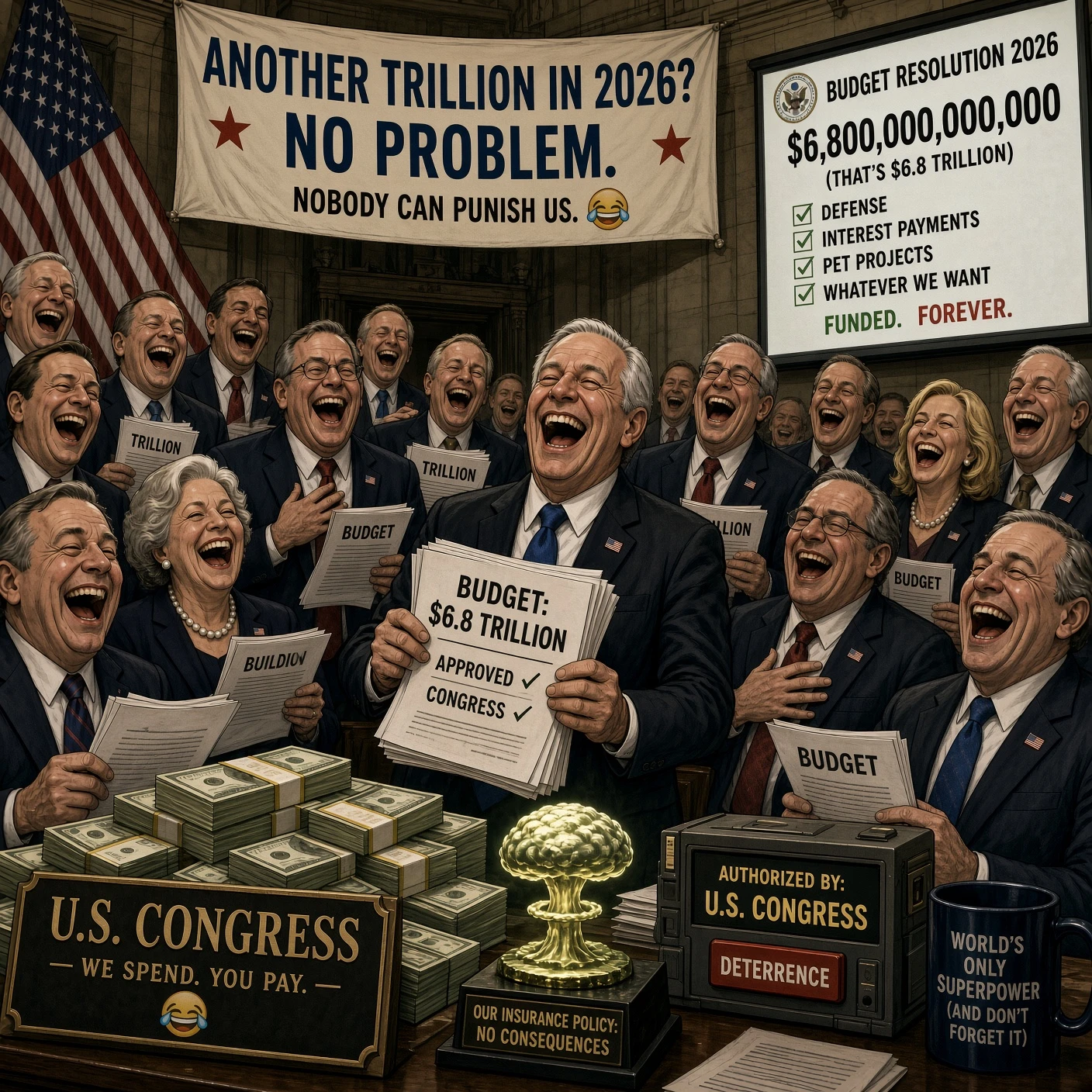
Congress Extends Spending Because No Creditor Can Collect Nuclear Debt by Grok is licensed under Grok xAI
Congress Extends Spending Because No Creditor Can Collect Nuclear Debt

Betting Odds Favor Trump Strait After Gulf and Lake America
He's Straight...Not Gay! So...Irony Is The Rule Of The Day Over These Towel Head Faggots!

Erin Piacenti slain in Times Square; memes outrun the facts.
No Fat Chicks!

Whistleblower Who Exposed FBI Spy McGonigal Dies After Final Posts
Win Some - Lose Some?

Solomon at G20: Long View Still Brighter Than Headlines
The Long Game! The Future Is Bright!

Department of War Deploys Grok as American SkyNet Goes Live
Come With Me If You Want To Live! Are You Sarah Conner?
Yale Schooling and Defense of Fired Generals Force Driscoll Out
Alpha Only! No Beta!

Trump Orders DHS Voter Fraud Crackdown Across Nine Battleground States
Elections Will No Longer Be Fake And Gay! We Hope!

Bessent Presses Allies With Tariffs and Iran Isolation in Asheville
We Have The Best Gays...