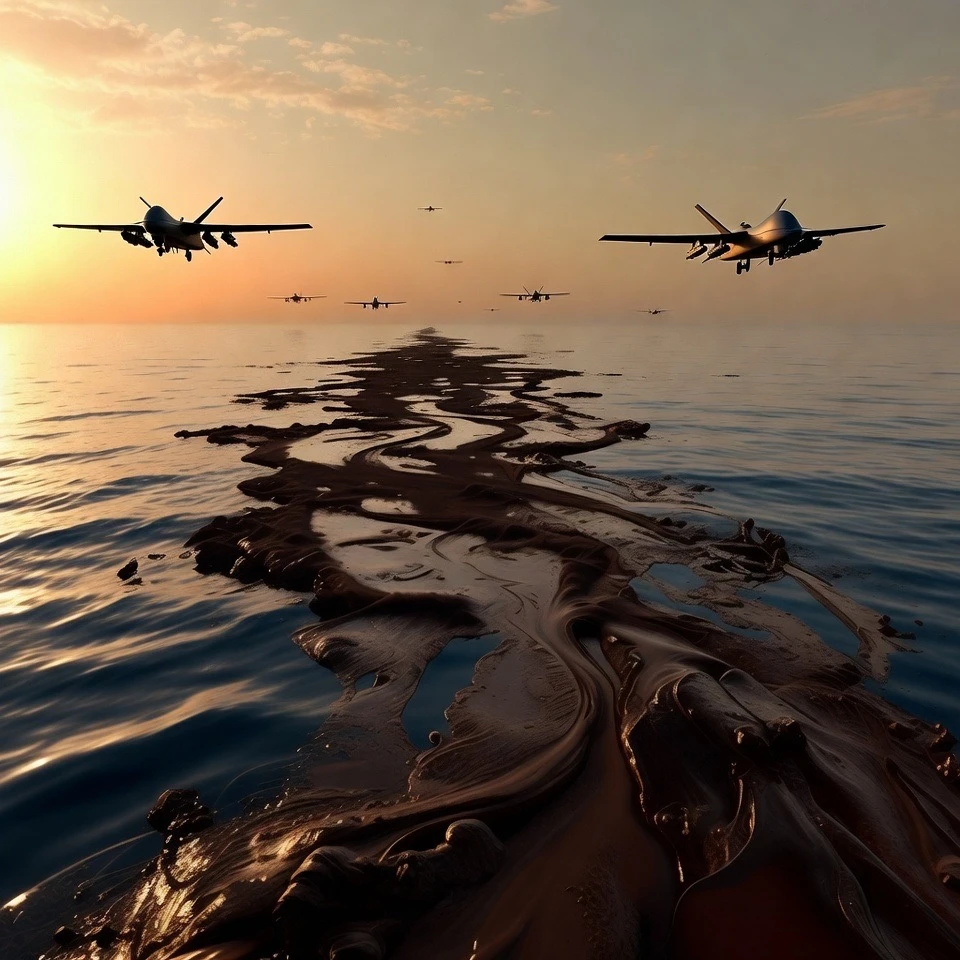
Two slicks have appeared in Iranian waters, confirmed by satellite imagery and video verified by Reuters, the visible residue of tit-for-tat attacks on oil tankers and other vessels by Iran and the United States. What begins as kinetic signaling between adversaries quickly becomes ecological liability: crude on the surface, currents carrying it toward sensitive coastlines, and the Gulf itself treated as collateral in a contest of will. The pattern is familiar to anyone who has watched the region since February—ships struck, insurance markets recoiling, and the narrow waterway reduced to a theater of managed risk rather than reliable commerce.
Outside the Strait, off Oman, a separate and more advanced disaster is already underway. The grounded tanker Caroline Bezengi, laden with Russian crude and long under sanctions, continues to leak into a protected marine area. Estimates of the resulting slick now reach as high as two thousand square kilometers. Salvage efforts lag; monsoon conditions complicate access; and the vessel sits as a slow-motion reminder that modern shadow fleets and contested sea lanes produce environmental consequences long after the initial explosion or grounding. The Gulf’s enclosed geography magnifies every barrel lost, turning tactical exchanges into lasting injury to fisheries, reefs, and the coastal populations that depend on them.
The Strait of Hormuz has been rendered functionally unreliable for ordinary international trade. Traffic has collapsed far below pre-war norms, insurance costs have soared, and each new attack further erodes the confidence required for routine transit. Whether the waterway recovers in years or remains constrained for decades will depend on whether the underlying contest is resolved or merely managed. In the meantime, the world’s energy markets are already forced to look elsewhere—pipelines, alternative suppliers, strategic reserves—because a chokepoint that can be closed by drones and mines is no longer a dependable artery.
Additional ADNN Articles:
Iran’s Stubborn Demands Fortify America’s Position as Global Energy Leader
Trump Seeks Diplomacy as Modern Warfare Empowers Iranian Hormuz Control
Trump Pauses Iran Strikes for Nuclear Deal and Hormuz Reopening
Houthi Missiles Strike Al-Mukha Port as Iran’s Leverage Fades
https://americansdirect.net/articles/irans-stubborn-demands-fortify-americas-position-as-global-energy-leader
https://americansdirect.net/articles/trump-seeks-diplomacy-as-modern-warfare-empowers-iranian-hormuz-control
https://americansdirect.net/articles/trump-pauses-iran-strikes-for-nuclear-deal-and-hormuz-reopening
https://americansdirect.net/articles/houthi-missiles-strike-al-mukha-port-as-irans-leverage-fades

Gulf Oil Slicks Signal End of Hormuz as Trade Route
Gulf Oil Slicks Signal End of Hormuz as Trade Route

Oslo honors a jurist, ignores Iran’s broken bomb and farm murders.
Peace? Fake And Gay Knows No Bounds!

Strasbourg’s gilded Trump satire admits the man it meant to mock.
TDS Is Real And On Par With Any Psychosis Known To Mankind!
SpaceX buys low-band spectrum; Starlink threatens the wireless oligopoly.
Can You Hear Me Now?
Rubio on the Pnyx: America Rejects Servitude, Decline, and Communism
#WLY - The Basis For All That Is Great!

France’s Student Demands Belong to a Century Already Dead
La mort de la France!

Pike Wakes Confused; Slemmer Still Visits Her Sleeping Hours
I See Dead People. Death On This Day!
Living Cells Carry a 71-Terahertz Signal That Dies With Them
You Are Electromagnetism!!!