The recent signing of the Prioritizing Patient Access to Care Act by Governor Maura Healey marks a decisive expansion of abortion authority in Massachusetts. By eliminating the Commonwealth’s prior 24-week gestational restriction and its accompanying statutory exceptions, the statute now permits abortion at any stage of pregnancy whenever a physician deems it appropriate under the elastic standard of “professional judgment.” The ceremonial presentation of this measure—conducted amid a gathering of advocates and officials—has become a point of sharp public contention precisely because it replaces clear temporal limits with an open-ended grant of discretion. What was once a regulated procedure after viability has been reconstituted as a matter left almost entirely to clinical preference, effectively authorizing termination up to the threshold of live birth.
Critics observe that this framework echoes the practical regime that prevailed nationally under the Roe v. Wade regime for half a century, when the “right to privacy” was construed to shield virtually unrestricted access. Massachusetts, in this view, is not inventing a novel principle so much as writing into positive law the very standard that progressive institutions long defended as constitutional orthodoxy. The decision to formalize that standard at the state level, after the Supreme Court returned the question to the states, signals an unbroken continuity of purpose: the progressive project remains committed to abortion without meaningful gestational boundary. Such continuity is not incidental; it is the logical outgrowth of an ideology that treats reproductive autonomy as the paramount civil right, superior even to the interests of a fully formed fetus capable of independent survival.
The political implication is difficult to evade. By embracing a policy that permits abortion on physician judgment through the ninth month, Democratic leadership in Massachusetts has made plain that its commitment is not to compromise or gradualism but to the maximal position—abortion today, tomorrow, and without fixed limit. That stance aligns with a broader progressive architecture in which the claims of the unborn are systematically subordinated to adult choice, and in which any residual legal restraint is treated as an unacceptable intrusion. The signing ceremony itself, whatever the personal circumstances of those present, has therefore come to symbolize not merely a technical adjustment of medical regulation but a public affirmation of an ideology that regards late-term abortion as an indispensable component of the larger cause.
Additonal ADNN Articles:
Trump Signs Orders Limiting Birthright Citizenship After Court Setback
DSA-Tied El-Sayed Wins Primary, Offers Pronunciation Lessons to Americans
Elite Betrayal of the Middle Class Fuels Youth Socialism Surge
Christian Nationalism Is Mere Race-Blind Universalism Wrapped in Traditional Values

Massachusetts Codifies Physician Judgment as License for Abortion Until Birth
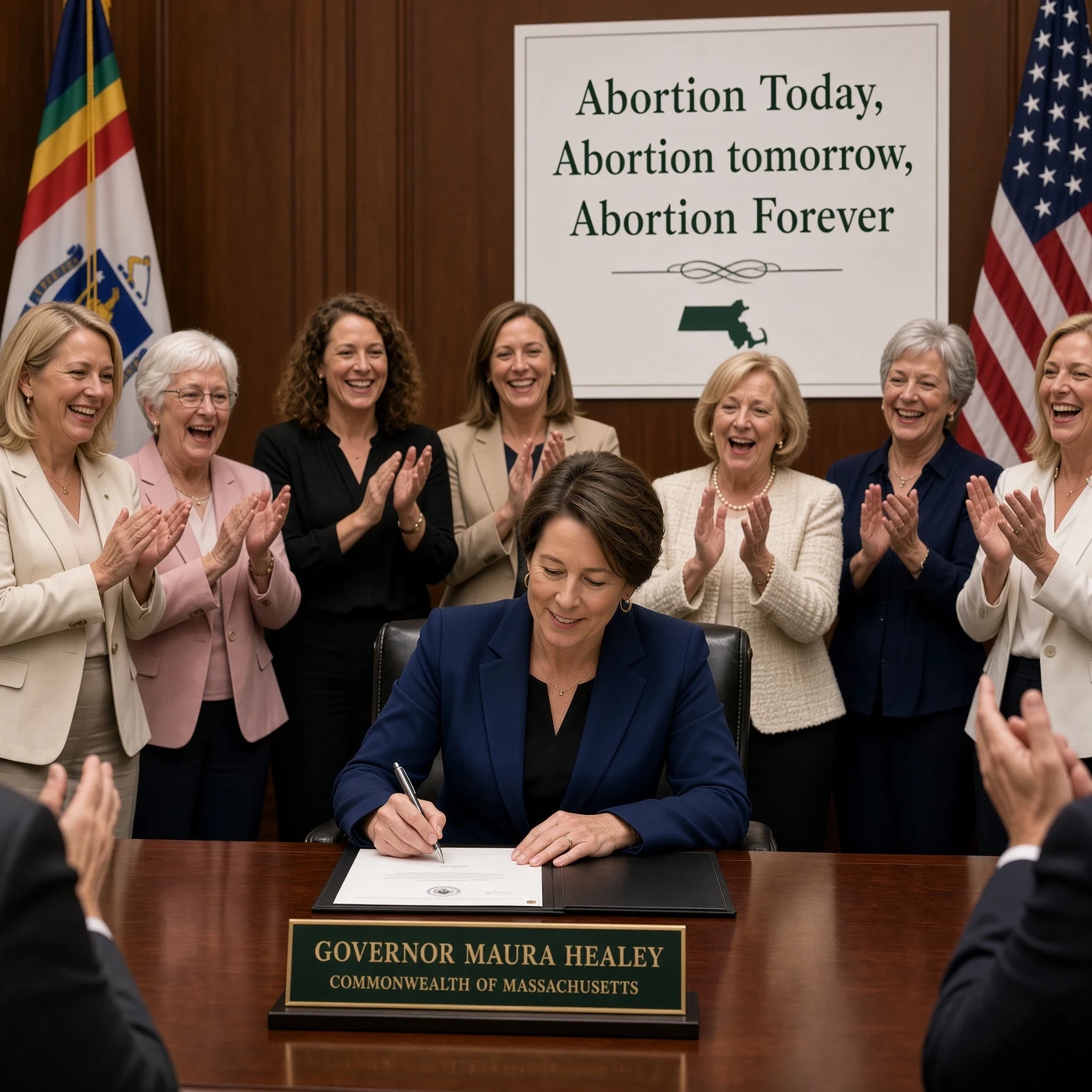
Massachusetts Codifies Physician Judgment As License For Abortion Until Birth by Grok is licensed under Grok xAI
Massachusetts Codifies Physician Judgment as License for Abortion Until Birth

Farmer’s Call Forces Rearrest of Five Over Fairford Plot
Arrest Them All!


You Built Pattern Recognition. What Did You Expect Would Happen?
Racism Is Real...Not Artificial.

USC Celebrates Illegal Hit on Top Prospect Dante Moore
Gridiron Games...


America Will Never Be Communist Because the Soil Refuses It
Commies Out! Better Dead Than Red!

Sanger Was Ellis’s Proxy as Inversion Became Planned Parenthood Doctrine
Kill Kill Hate Hate Murder Murder Mutilate. These Sickos Have Done Real Damage!