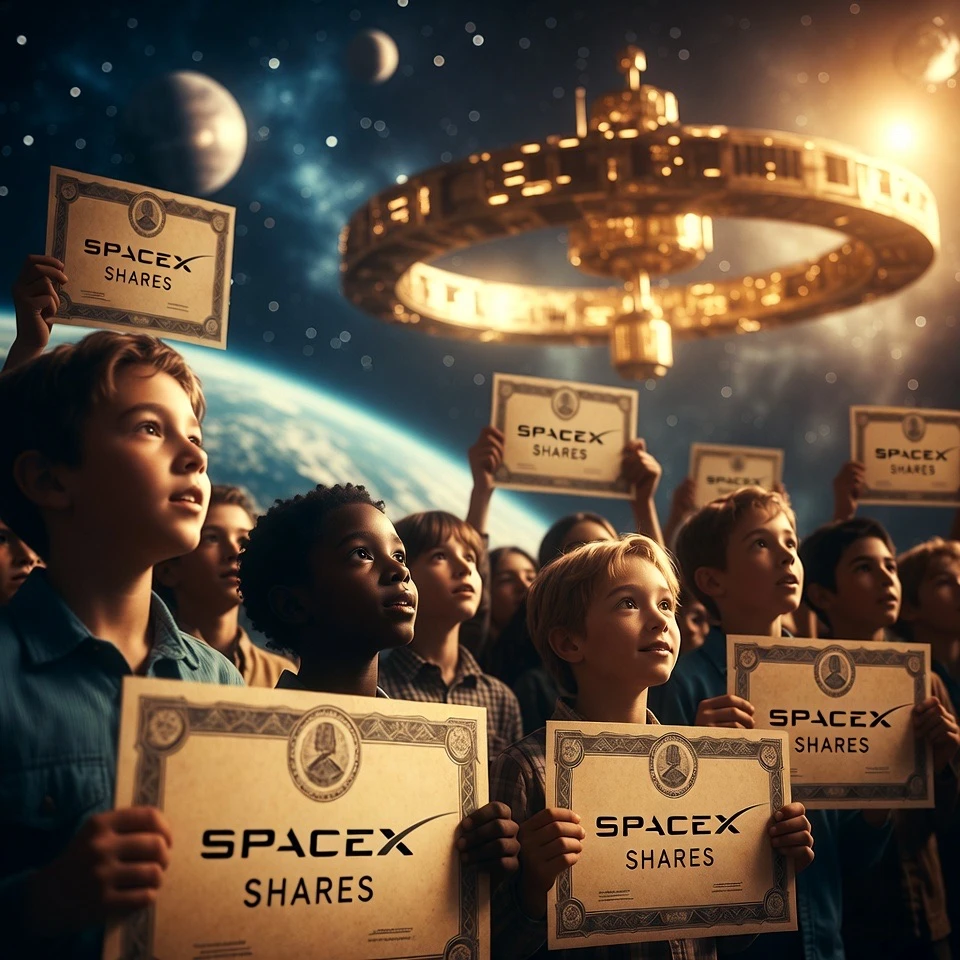
Elon Musk has announced that next year he will transfer one of his own SpaceX shares to each of the roughly seventy-two million Americans under eighteen, a distribution whose market value stands near ten and a half billion dollars at recent closing prices. The pledge arrived hours after Anthropic disclosed its intention to place at least five percent of its equity—and potentially more as the company’s valuation rises—into a Public Benefit Fund that would channel resources toward nonprofits and AI-safety projects. Musk’s rejoinder was characteristically direct: better to hand the shares to the public itself than to interpose another layer of trustees and grant-makers.
The distinction is not merely procedural. An ownership society, properly understood, rests on the premise that productive assets should rest in the hands of citizens rather than in perpetual foundations whose managers answer chiefly to one another. Anthropic’s vehicle, structured as a wholly owned limited-liability company, preserves board discretion over both the additional equity that may flow into the fund and the ultimate destinations of its resources. Musk’s alternative, however incomplete its present details, at least begins from the opposite premise—that the next generation of Americans should hold a claim on the enterprise that is sending rockets into orbit and building the infrastructure of the emerging space economy. Supporters therefore describe the gesture as an extension, in private form, of the same impulse that has produced Trump Accounts and similar efforts to place a modest stake in every young citizen’s name.
Practical questions remain, and they are not trivial. Distribution to minors will require custodians, trusts, or some comparable mechanism; tax treatment is unaddressed; and the post itself does not specify whether eligibility is limited to citizens, to lawful residents, or simply to every person under eighteen counted by the Census. Those ambiguities will have to be resolved before the pledge can be executed. Yet the underlying contrast with the fund model is already clear enough. One approach keeps control inside the company and its designated intermediaries; the other, if carried through, places a concrete fractional claim on a high-growth enterprise directly into the hands of the generation that will live with the consequences of the present technological transition. In that sense the announcement continues a longer American argument about whether wealth created by private enterprise is best shared by expanding the number of owners or by enlarging the endowments of those who claim to speak for the public good.
Additional ADNN Articles:
Musk Drops AI for SI, Renames SpaceXAI to SpaceXSI
SpaceX buys low-band spectrum; Starlink threatens the wireless oligopoly.
French Foundry Raises Fifty-Foot Prometheus Beside Starbase, Unasked and Unpaid
World’s Richest Man Still Sleeps in a Trailer Anyway

Musk to Give One SpaceX Share to Every American Child
Musk to Give One SpaceX Share to Every American Child
Louis Alphonse Offers Throne as Fifth Republic Collapses Amid Unrest
Will To Power! Divine And Definite!

Seize Power First to Reshape the Beliefs of Women
Wear The Bonnet!
On This Day Cornwallis Surrenders at Yorktown Ending Revolutionary Combat
Yes But War Continues To This Very Day. Trump Is About To End it Once And For All!
The Same Governing Class Imposed Open Borders Everywhere, Then Lied.
Conspiracy Reality!

Limoges Town Hall Burns After Decades of Ignored Assimilation Warnings
France Must Find The Will To Live! Vive La France!
Suicidal Empathy: The West’s Kindness Turned Against Its Own
Mind Control Is Real!! What Does She Really Want? To Shop At Hermes, The Freedom To Fuck Mandingo BBC, To Defend That Same Savage, And Ultimately To Cut Her Son's Dick Off, So She Can Have A Tranny. She Can't Be trusted! What Is She Really? Repeal the 19th...Wear The Bonnet!

Slotkin’s Prosecutions Aim to Drive Conservatives From Public Life
Fear And Loathing In America! These Sickos Must Be Stopped!
Trump Names Mohammed El-Sayed, Citing Brotherhood Ties in Michigan Race
Elections Are Fake And Gay...And Guess What...So Is Mohammed!