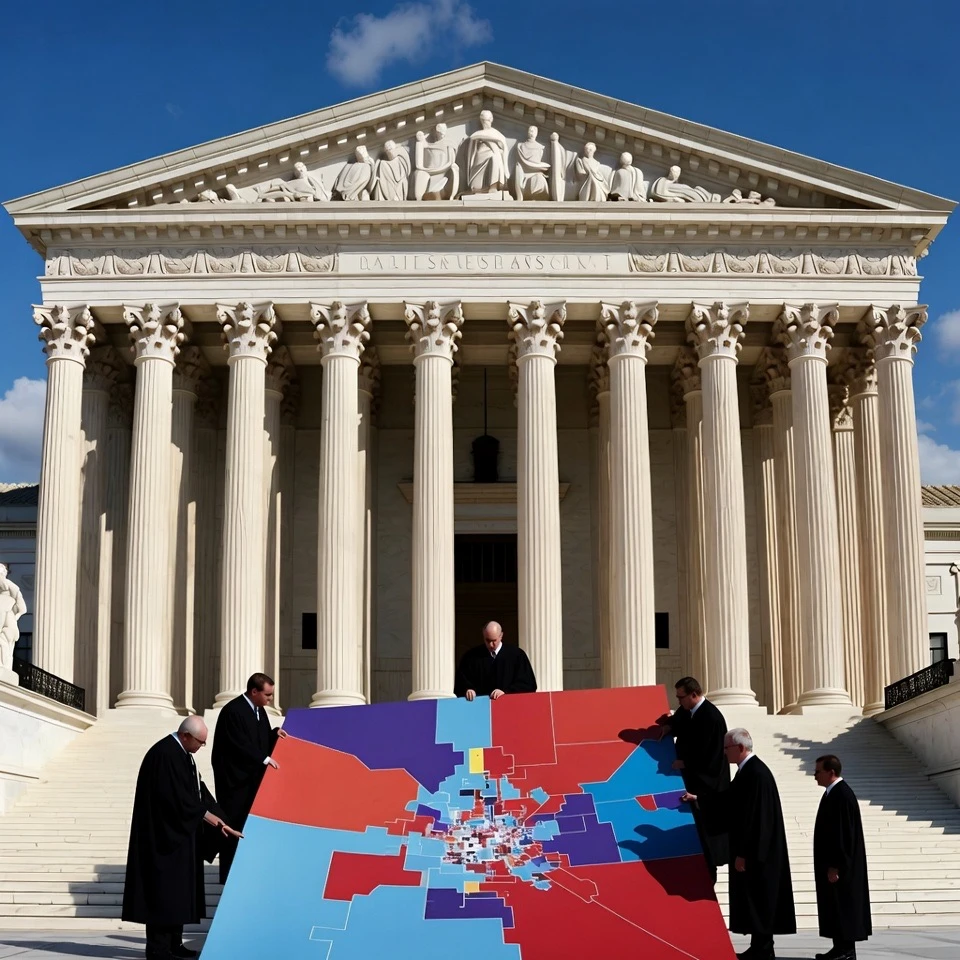
The U.S. Supreme Court today issued a 6-3 decision in Louisiana v. Callais that significantly narrows the application of Section 2 of the Voting Rights Act of 1965.2025 The ruling addresses Louisiana’s congressional map, which included a second majority-Black district drawn to comply with prior lower-court findings of vote dilution under the VRA. Justice Samuel Alito wrote for the majority that while Section 2 itself remains intact, its use must not lead to unconstitutional racial gerrymandering. The Court emphasized that race cannot be the predominant factor in drawing districts without satisfying strict scrutiny under the Equal Protection Clause of the Fourteenth Amendment.
Critics of expansive VRA interpretations have long argued that Section 2, particularly its “effects” test established in Thornburg v. Gingles (1986), has been used to mandate race-conscious map drawing that effectively prioritizes racial outcomes over traditional districting principles like compactness and respect for political subdivisions.23 Today’s opinion reinforces that states cannot engage in what amounts to racial balancing or packing to create safe minority districts if race predominates, framing such practices as discriminatory in their own right. This aligns with precedents like Shaw v. Reno (1993) and subsequent cases limiting bizarrely shaped districts justified primarily by race. Proponents of the decision view it as curbing a mechanism that incentivized racial categorization in elections, moving the country closer to color-blind districting where maps are drawn based on neutral criteria rather than achieving proportional racial representation.
The decision is being hailed by opponents of race-based policies as a step toward equal treatment under the law for all Americans, regardless of race. It limits the ability of litigants to leverage the VRA to force maps that treat voters differently based on skin color, potentially opening the door for states to redraw lines without the threat of lawsuits demanding specific racial compositions. Liberals dissenting argued this guts key protections against dilution of minority voting strength.21 Supporters counter that true non-discrimination requires rejecting any legal framework that presumes certain racial groups need engineered electoral advantages, emphasizing individual voter equality over group entitlements. This ruling continues the Court’s post-Shelby County (2013) trajectory of scrutinizing provisions that single out jurisdictions or voters by race.
Additional ADNN Articles:

Supreme Court Gutted Racist Voting Rights Act Provision
Supreme Court Gutted Racist Voting Rights Act Provision

War Department Thingamabob Rainbows Tehran Sky, Unsettling Guards and Globalists
A Heap Of Homo Hooligan Hell Hole Rainbow Lights Shock The Sand People. Was It US? Or Enoch? Or Some Other Alien?

Bessent Pins Hugging Face Incident on OpenAI Managers, Not Agents
Bots Aren't Gay...

Austin Protesters Learn Texas Differs From Minnesota After ICE Clash
Don't Mess With Texas!

Fonzie Jumped the Shark; Fifty Years of Failure Endure
Fake And (Almost Certainly) Gay - Jewish Greaser, Mind Control And The Pop-Culture Term That Lives On...

Ukraine’s Swarm Hits Moscow Refinery as Russia Warns Retaliation
World War Three, Anyone?

Iran Issues Code 100 as Trump and Netanyahu Rush Home
Turn Up The Volume!

Trump Forms AI Force and Czar; Will Not Stifle Industry
May The Force Be With You! Superior Intelligence Is The New AI!

No First Amendment Right To A Seat In West Wing
Mockingbird Press Pissed At Being Locked Out As They Are The "Deep-State-Run-Media" - The Propaganda Arm Of The Intelligence Community Driving Mind Control - Fucking Commies! God To Hell You Sickos!